


A demo lesson for an English teaching interview is a short chance to show how you help a learner use English. It may be a few minutes with an interviewer acting as a student, or a longer session with supplied materials. The length, learner profile and criteria vary by school, so confirm the instructions before you prepare.
This guide walks through the process from the brief you receive to the feedback you give at the end. It is especially useful for a conversation school, or 英会話 (eikaiwa), where an adult learner needs meaningful speaking time. If you are still comparing different roles, start with our eikaiwa job checklist.
Before you plan: clarify the brief
Read the invitation carefully. If something important is missing, ask a concise question rather than guessing. A five-minute demonstration for a beginner adult is different from a thirty-minute class for children.
- Time: How many minutes are available, including any setup or reflection?
- Learner: Who will play the student, and what level or goal should you assume?
- Materials: Must you use a supplied textbook or can you bring a simple prompt?
- Format: Is it one-to-one, a group, in person or online?
- Assessment: Will the interviewer stop you, ask questions or provide feedback afterward?
Use any materials the school provides. If you can choose a topic, choose one you can turn into an actual learner task in the time allowed. Familiar everyday situations usually work better than a complicated grammar lecture.
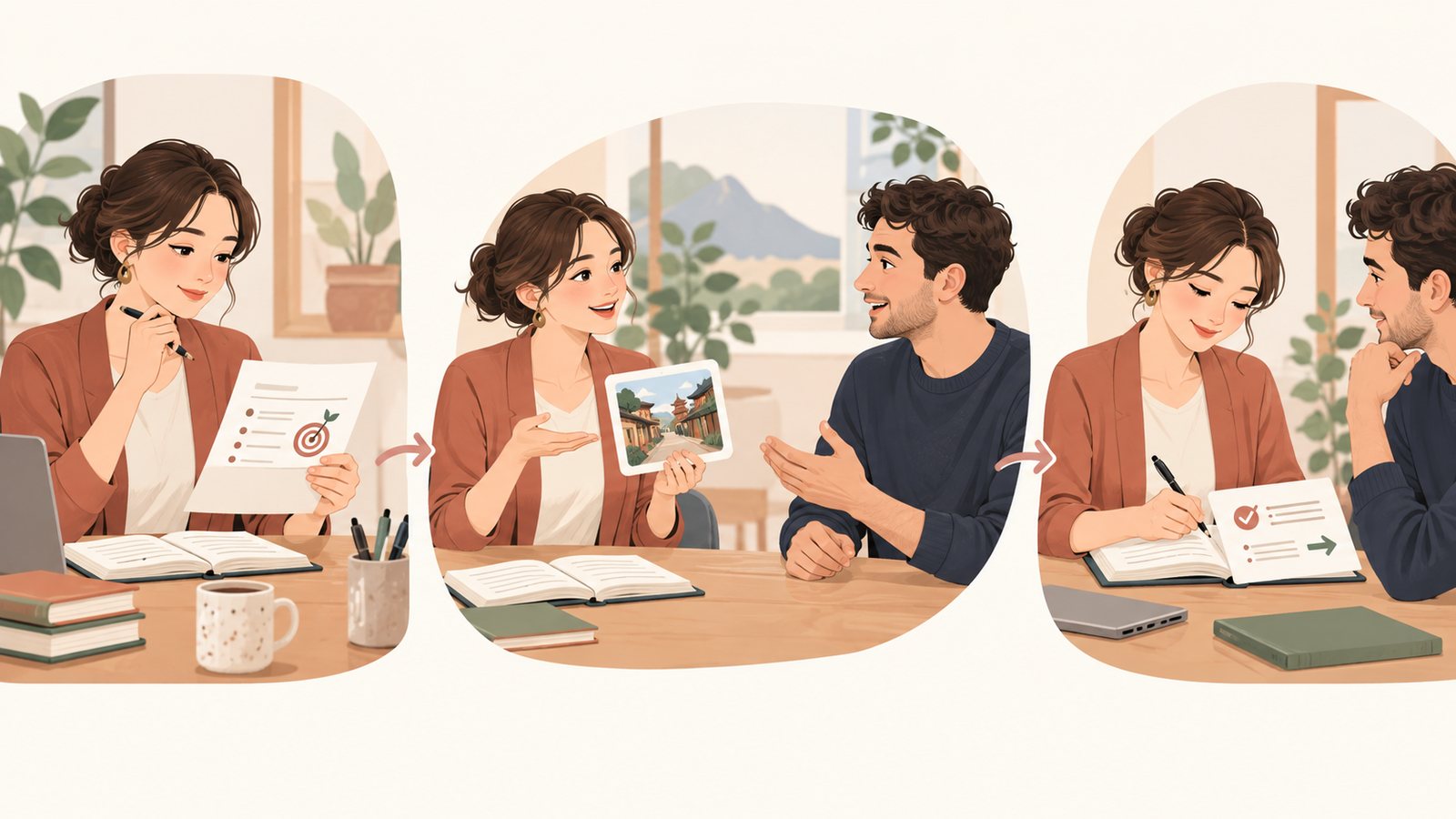
Build a small lesson with a clear outcome
Write one sentence beginning, “By the end, the learner can…” For example: ask for a recommendation in a café and respond to a suggestion. This is narrow enough for a short demo and gives you a way to check whether the lesson worked.
| Stage | What you do | What the learner does |
|---|---|---|
| Set the situation | Give a short, concrete prompt. | Recognize the setting and goal. |
| Model | Offer one or two useful phrases in context. | Hear or read a natural example. |
| Practice | Ask a question or begin a role-play. | Use the phrases for their own answer. |
| Respond | Notice what worked and address one useful point. | Try again with more clarity or confidence. |
For a very short demo, each stage may take less than a minute. Leave a little room for the learner to hesitate, ask a question or take the conversation somewhere unexpected. The plan is a guide, not a script that must survive unchanged.
During the demo: listen and adjust
Give the learner a reason to speak
After a brief model, ask an open but manageable question. “What would you order, and why?” gives more room than “Do you understand?” If the learner is quiet, reduce the task: offer two choices, demonstrate an answer, or let them finish a sentence. Avoid filling every pause yourself.
Check understanding without a long quiz
Ask the learner to use the phrase or explain the choice in a new example. Their response tells you more than a yes/no confirmation. If confusion appears, change the example or simplify the wording, then invite another attempt.
Correct with care
Choose a correction that helps the learner meet the lesson goal. During a role-play, you might note a recurring issue and return to it afterward. If a mistake prevents communication, a brief prompt or reformulation can help immediately. Correcting every word may leave little time for speaking.
Make eye contact and speak clearly, but concentrate on the learner rather than performing a cheerful persona. Interviewers may be looking at different qualities; there is no single acting style that guarantees success.
A sample five-minute demo
Goal: The learner can ask a colleague for a convenient meeting time and respond to a proposed time. This is one example, not a required interview task.
- 0:00–0:45 — Context: “You need to arrange a short meeting with a colleague. When are you free?” Listen to the first attempt.
- 0:45–1:45 — Model: Offer “Would Tuesday afternoon work for you?” and “I could do Wednesday morning instead.” Let the learner notice how an alternative is offered.
- 1:45–4:00 — Practice: Take the colleague’s role. Suggest a time that does not work; invite the learner to propose another. Adjust your question if they need support.
- 4:00–5:00 — Feedback and retry: Point out one effective phrase and one useful improvement. Repeat a short exchange so the learner can use the feedback.
Practice with a timer, but do not rush through a memorized speech. If the interviewer asks you to change the learner level or material, explain your adjustment briefly and continue teaching.
After the lesson: reflect on the learner
If asked to evaluate your own demo, be specific: what could the learner do by the end, what was difficult, and what would you do next? “I would give the student a new meeting scenario to see whether they can offer an alternative independently” says more than “I think it went well.”
For focused extra practice, see our three short demo-lesson tips. Our article on a second-round, one-to-one demo looks more closely at a learner’s questions, speaking time and correction. Schools can use different interview processes; rely on the current invitation for your own interview.
Choose a role that suits the way you teach
A demo lesson also lets you see the school’s expectations. Ask about lesson goals, supplied materials, training and feedback, as well as the employment terms. You can compare the group, children’s and one-to-one teaching formats before choosing where to apply.
If teaching adult learners individually sounds like a fit, read about working at b Watashino Eikaiwa and check the current Lesson Partner information.