


If you are applying for an English teaching job in Japan, your resume should make three things easy to see: who you have taught, how you help learners, and whether you can work in the role advertised. A clean, tailored document is more useful than a long list of every job you have ever held.
Start with the employer’s application instructions. Some schools request an English resume; others ask for a Japanese-style rirekisho (履歴書) or a separate work-history document, shokumu keirekisho (職務経歴書). Send the format and materials they ask for rather than assuming one style works everywhere.
1. Put the teaching match near the top
Use your name, contact details, and a short profile that reflects the specific opening. Then place your most relevant teaching experience, training, and skills where a reader can find them quickly. If the position involves adult conversation lessons, describe your experience with adults and one-to-one instruction. If you have taught children or groups, make that clear too.
A useful profile is specific without making claims you cannot support:
English instructor with two years of experience teaching one-to-one conversation lessons to adult beginners. I plan speaking activities around learners’ goals and give clear, encouraging feedback.
That tells a school more than “passionate teacher seeking a challenging position.” If you are new to teaching, lead with relevant tutoring, mentoring, facilitation, customer-facing work, or language exchange experience and explain the connection honestly.
2. Show what you actually did
For each relevant role, include the organization, location or online setting, dates, audience, and a few concise bullets. Describe the work in concrete terms. Numbers can help when they are accurate, but you do not need to invent results.
- Vague: “Taught English and helped students improve.”
- Clearer: “Planned weekly 50-minute conversation lessons for adult beginners; used role plays and follow-up notes to help learners practice everyday situations.”
- Clearer: “Adapted activities to learners’ goals and checked understanding before moving to a new topic.”
Include the languages you can use with learners or coworkers if they matter to the role. State your level plainly. A qualification such as a teaching certificate can be listed with the issuer and completion date; do not imply it is required for every English teaching position.
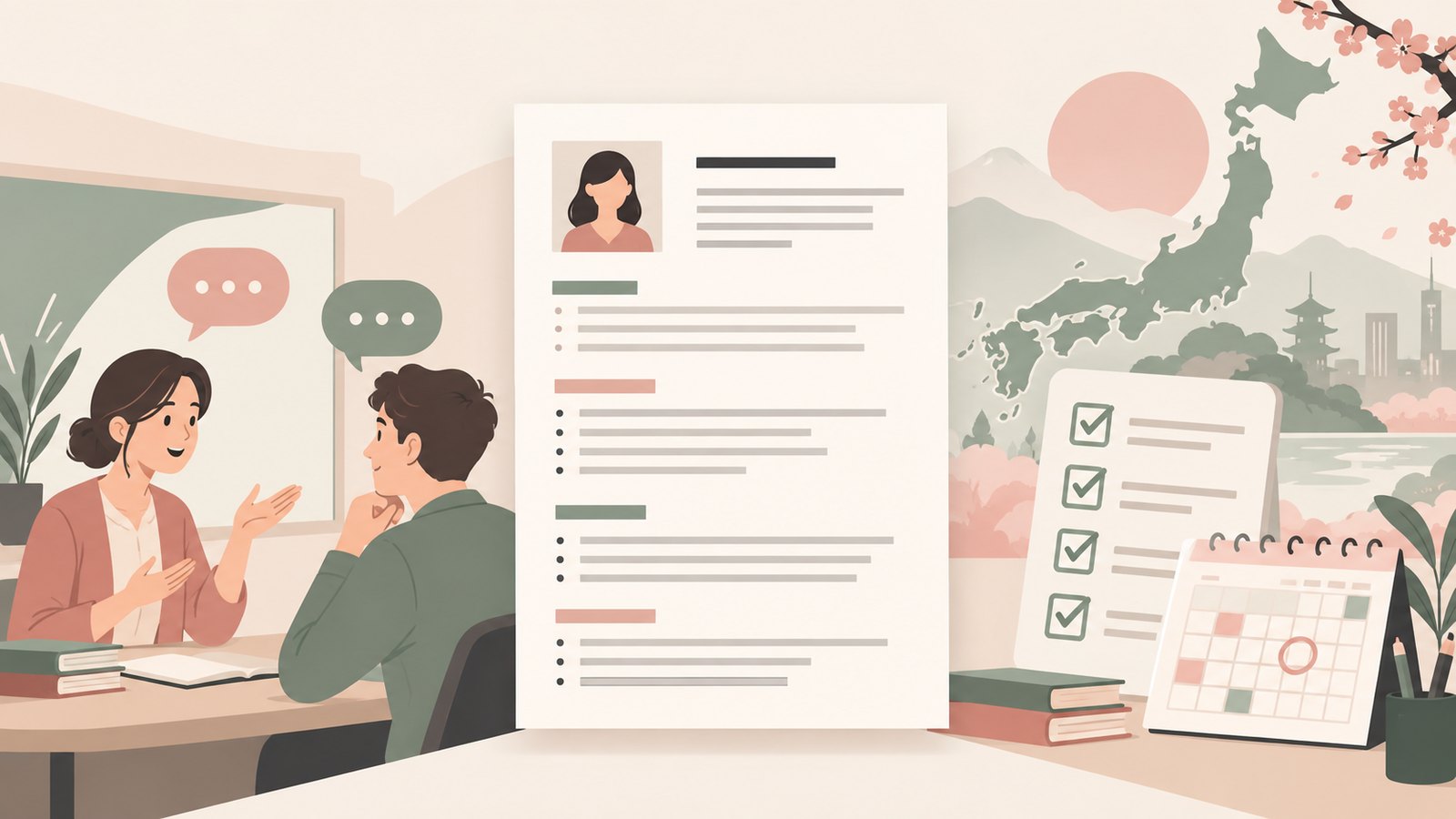
3. Keep the layout easy to scan
Use clear headings, consistent dates, readable type, and enough spacing. One page can work for a newer applicant; two pages may be sensible when you have substantial relevant experience. Cut unrelated detail before shrinking the text until it is hard to read.
Use reverse chronological order for your experience and explain major career changes briefly when that helps a reader understand the story. If you submit a PDF, check that it opens properly and that links and text are selectable. Use a simple filename such as First_Last_English_Teacher_Resume.pdf. If the employer requests a different file format or a form, follow that instruction.
4. Handle Japan-specific details carefully
Residence and work eligibility
When an employer asks, state your current location in Japan and your current residence or work status accurately, including any relevant work restrictions. Do not guess at eligibility or describe a status you expect to obtain as one you already hold. Requirements vary by job and individual circumstances, so check the current job posting and official guidance for questions about permission to work.
Photo and personal information
A photo is common on some Japanese application forms, but it is not a universal requirement for an English-language resume. Include one when the employer specifically asks for it; otherwise follow the application instructions. Avoid adding unrelated personal details merely because an old template has a space for them.
English resume or Japanese forms
A Japanese rirekisho (履歴書) is a particular application format, not just an English resume translated word for word. If a school asks for one, use the requested form and check its fields carefully. The same goes for a shokumu keirekisho (職務経歴書), which gives fuller work history. If only an English resume is requested, a clear English format is appropriate.
5. Tailor the application to the school
Read the job page again before you send anything. Does the school teach adults or children? Are lessons one-to-one or in groups? Is the role in person, online, or both? Select examples that match those facts. A few tailored lines in your profile and experience bullets are usually enough; avoid copying the job description wholesale.
Check the school name in your email or cover note, and make sure attachments match the role. Never claim to have taught a learner group or used a method you have not actually worked with. A candid explanation of transferable experience is stronger than an inflated one.
Before you press send
- Does the first section tell the employer what kind of teaching you can do?
- Are job titles, dates, qualifications, and contact details accurate?
- Have you followed the posting’s requested documents and file format?
- Are school names and attachments correct for this application?
- Have you proofread the final exported file, ideally after a short break or with a second reader?
Your resume opens the conversation; the interview and teaching demonstration show how you work with a learner. Once your application is ready, read our guides to choosing an eikaiwa, planning a demo lesson, and preparing for a second-round demo.