

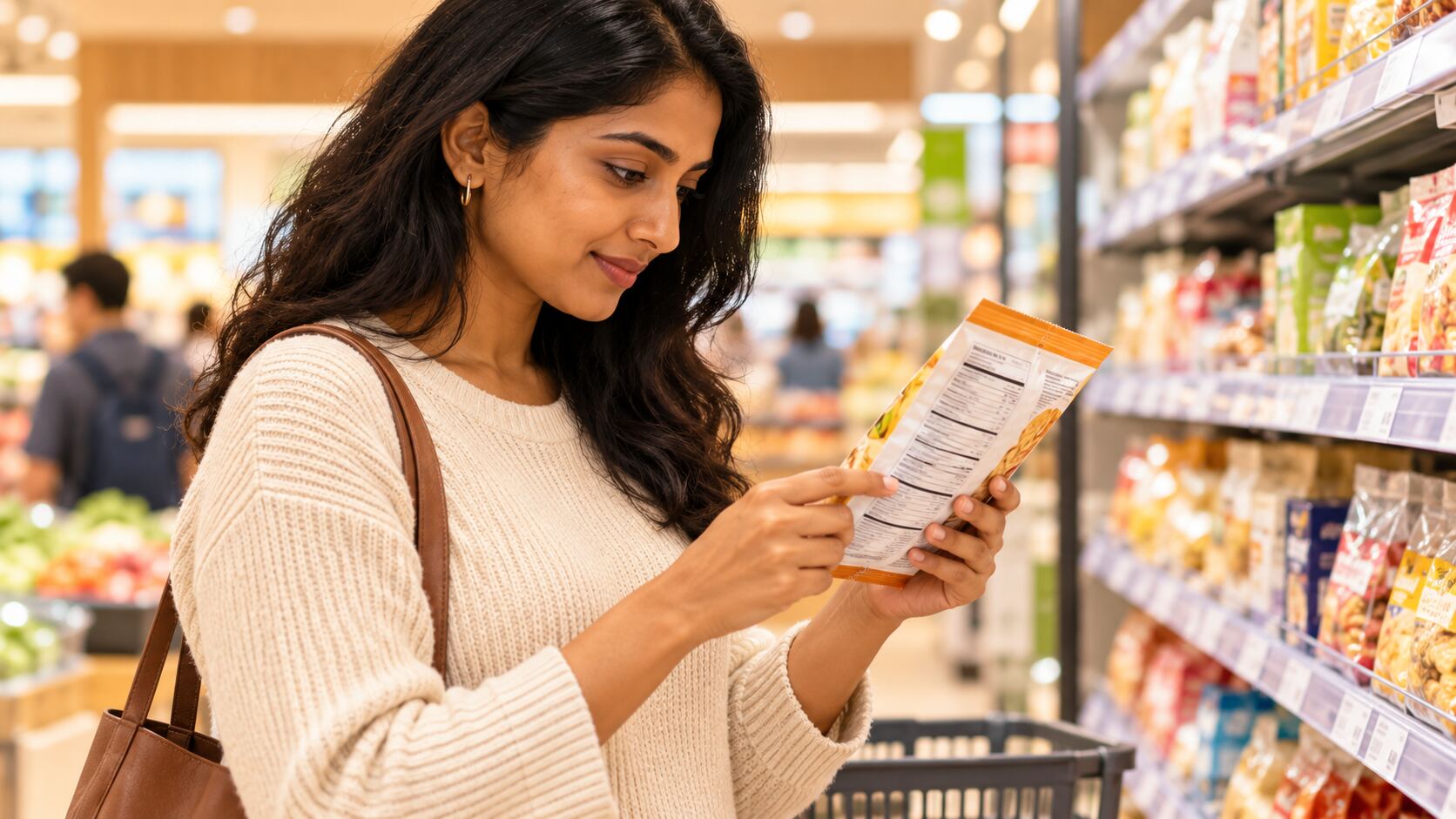
You are holding a Japanese snack and need to know whether it contains an ingredient you avoid. Turn to 原材料名 (ingredients), read the entire line—including text in parentheses and after the slash—and look for wording such as 一部に小麦・乳成分を含む (“contains wheat and milk components”). For a serious food allergy, do not decide from a picture, an app translation or the absence of one word alone. If the current package is unclear, contact the manufacturer before eating it.
Japanese label words to find
| Japanese | Reading | Meaning | Where to look |
|---|---|---|---|
| 原材料名 | genzairyōmei | Ingredients | The main ingredient and additive listing. |
| 添加物 | tenkabutsu | Additives | May appear after a slash or separately; allergen origins can appear here too. |
| アレルゲン / アレルギー物質 | arerugen / arerugī busshitsu | Allergen / allergenic substance | Some packages also provide a prominent summary. |
| 〜を含む | 〜 o fukumu | Contains ~ | Can follow an individual ingredient in parentheses. |
| 一部に〜を含む | ichibu ni 〜 o fukumu | Contains ~ among its ingredients | Often appears together near the end of the ingredient line. |
| 〜由来 | 〜 yurai | Derived from ~ | Can identify the source of an additive. |
| 本品製造工場では〜を含む製品を製造しています | honpin seizō kōjō de wa 〜 o fukumu seihin o seizō shite imasu | Products containing ~ are made in this factory | A precautionary factory statement; ask the maker about your risk. |
| お客様相談室 / お問い合わせ | okyakusama sōdanshitsu / otoiawase | Customer service / inquiries | Contact point when the label is not enough. |
Read both forms of allergen disclosure
Japan’s Consumer Affairs Agency explains two ways an allergen may appear: individual labelling next to an ingredient, such as マヨネーズ(卵を含む), and collective labelling at the end, such as (一部に卵・大豆を含む). Additives can also say 乳由来 (“derived from milk”). Its April 2026 allergen-labelling handbook shows these formats. Read the full original label, not just a bold callout on the front.
For example, 原材料名:小麦粉、砂糖、チョコレート(乳成分を含む)/乳化剤(大豆由来) tells you that wheat flour is an ingredient, the chocolate contains milk components, and the emulsifier is derived from soy. This is an illustrative reading exercise, not a real product’s verified label.
Which allergens are in Japan’s required list?
As of September 2026, the agency lists nine specified ingredients for mandatory allergen labelling of packaged processed foods containing them: えび (shrimp), カシューナッツ (cashew nut), かに (crab), くるみ (walnut), 小麦 (wheat), そば (buckwheat), 卵 (egg), 乳 (milk), and 落花生/ピーナッツ (peanut). The agency also has a separate list of 20 ingredients for which labelling is recommended rather than mandatory, including soy, sesame, almond, pistachio and macadamia nut. Check the agency’s current allergen page for updates.
Cashew nut joined the mandatory list on April 1, 2026. The agency’s notice provides a two-year transition period for businesses. If you have a cashew allergy, do not treat a missing cashew word on a package as proof of safety during this transition. Older English-language charts may still show an earlier list; use current Japanese information and contact the manufacturer about the exact product.
A safe three-step check in the shop
- Read the current package. Find 原材料名 and any separate allergen statement. Do not rely on a shelf label, a photo from last month or a product with similar packaging.
- Check all the places an ingredient can appear. Read the ingredient names, parentheses, collective statement, additives and any factory precaution. The absence of a factory warning is not a guarantee against unintended contact.
- Resolve uncertainty before eating. Use the customer-service contact on the package, and identify the exact product and lot if requested. If you cannot get a clear answer for a serious allergy, choose another product.
Packaged processed foods are the focus of the mandatory list described above. Food prepared or served without a package can involve different information and handling. Ask the business directly about ingredients and preparation; do not assume the same label format applies to a bakery case, restaurant meal or loose deli item.
Questions to show a staff member or manufacturer
| Japanese | Reading | Meaning |
|---|---|---|
| この商品には小麦が含まれていますか。 | Kono shōhin ni wa komugi ga fukumarete imasu ka? | Does this product contain wheat? |
| 原材料とアレルゲンを確認したいです。 | Genzairyō to arerugen o kakunin shitai desu. | I would like to check the ingredients and allergens. |
| 製造時の混入について確認できますか。 | Seizōji no konnyū ni tsuite kakunin dekimasu ka? | Can you confirm possible contact during manufacturing? |
| メーカーの問い合わせ先を教えてください。 | Mēkā no otoiawase-saki o oshiete kudasai. | Please tell me how to contact the manufacturer. |
Point to your exact package when asking. Staff may not know the manufacturing details, so request the manufacturer’s contact rather than accepting a guess. For other food-panel terms such as 消費期限 and 保存方法, see our date and storage guide. Our grocery shopping guide covers the broader supermarket routine.