

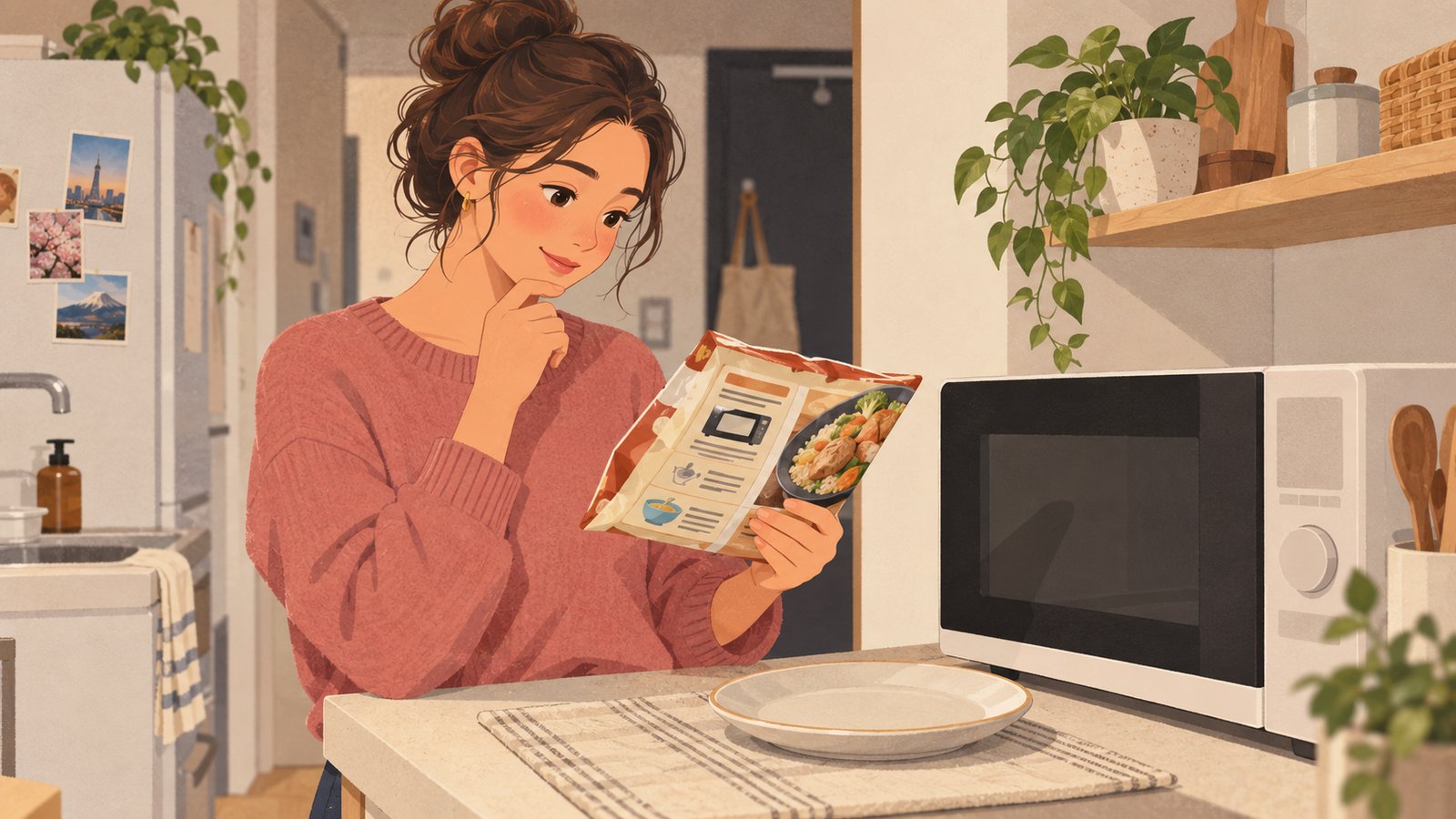
You have a meal in front of a Japanese microwave and the buttons say あたため, 解凍 and レンジ. For a ready-to-eat meal, あたため means “reheat.” 解凍 means “defrost,” often for raw frozen ingredients, and is not the same as reheating frozen rice or a cooked meal. Check the food package and your machine’s manual before selecting a mode; controls differ by model.
Japanese microwave buttons and display words
| Japanese | Reading | English | Typical use |
|---|---|---|---|
| あたため/温め | atatame / atatame | Reheat | Warm a prepared food; automatic program on some models |
| レンジ | renji | Microwave mode | Select microwave power and time manually on some combination ovens |
| 解凍/全解凍 | kaitō / zen-kaitō | Defrost / full defrost | Thaw ingredients according to the model’s instructions |
| 冷凍食品 | reitō shokuhin | Frozen food | Model-specific automatic program |
| 飲み物/牛乳 | nomimono / gyūnyū | Drinks / milk | Dedicated beverage mode, if supplied |
| 出力/ワット(W) | shutsuryoku / watto | Power in watts | Match the food package’s wattage and time |
| 時間 | jikan | Time | Set the heating duration |
| スタート/決定 | sutāto / kettei | Start / confirm | Begin or confirm the selected setting |
| 取消/とりけし | torikeshi | Cancel | Stop or clear a selection |
| オーブン/グリル | ōbun / guriru | Oven / grill | Different heating methods; cookware rules may differ |
These are common examples rather than a universal panel. One Sharp manual shows レンジ, グリル, オーブン, 解凍 and スタート/決定 on its controls, while another model uses あたためスタート and とりけし. Find your exact model number and manual when the controls differ from this table.
How to reheat a supermarket meal
- Read the package. Look for 電子レンジ (denshi renji, microwave), 500W/600W and the stated time. Follow directions about removing film, sauce packets or the food from its tray. “Microwave safe” applies to the container only when the package says so.
- Use a suitable container. Transfer food if the packaging does not permit microwave heating. Remove metal and foil. Panasonic warns that metal containers, foil and certain retort pouches can spark in microwave mode; follow the package and machine instructions. See its appliance safety guide.
- Select the right mode. If the package specifies power and time, choose manual レンジ mode where available, set the wattage and duration, then press スタート. Panasonic recommends following the printed wattage and time for prepared meals instead of assuming an automatic program will suit them. See its prepared-meal guidance.
- Check after heating. Food and containers may be hot, and heating can be uneven. If more time is needed, add a short interval using the package and manual as guides.
For package terms such as 加熱 (kanetsu, heating) and 解凍 (kaitō, thawing), see our frozen food instruction guide. It helps you read the food’s directions alongside the appliance panel.
For frozen rice, あたため or a model’s ごはん program may be appropriate; raw meat or fish uses a defrost program according to the manual. Panasonic explicitly distinguishes these cases in its defrost guidance.
Important mistakes to avoid
- Do not use a metal tray or foil in microwave mode. A combination oven may allow a supplied tray for an oven or grill function while prohibiting it in レンジ mode. Check the manual for the mode you selected. Panasonic explains the sparking risk.
- Do not heat a whole egg or a sealed bottle. Pressure can build and cause bursting. Read the manufacturer’s safety instructions for foods with skins or membranes, lids and containers.
- Take care with drinks. Overheating can cause sudden boiling when disturbed. Sharp advises using a dedicated 飲み物 or 牛乳・酒 mode where provided. See Sharp’s microwave support page. Follow your model’s directions and handle a hot drink carefully.
- If you see sparks, smoke or unusual behavior, stop using the machine. Follow the manufacturer’s safety and inspection instructions; do not continue reheating to “see if it happens again.”
Useful Japanese to ask a host or colleague
| Japanese | Reading | Meaning |
|---|---|---|
| これは電子レンジで温められますか。 | Kore wa denshi renji de atatameraremasu ka? | Can I heat this in the microwave? |
| この容器は使えますか。 | Kono yōki wa tsukaemasu ka? | Can I use this container? |
| 500ワットはどこで設定しますか。 | Go-hyaku watto wa doko de settei shimasu ka? | Where do I set 500 watts? |
| いったん止めたいです。 | Ittan tometai desu. | I’d like to stop it for now. |
Our Living in Japan guide connects appliance guides with other everyday tasks and documents.
If you are setting up a home in Japan, our air-conditioner remote guide explains another unfamiliar appliance. For food shopping, see the grocery-store guide.