


Good time management for an English teacher starts before the lesson and continues through the final minute. Two useful habits are planning the commute with a way to notify the school if something changes and giving each lesson a clear, unhurried ending. The exact schedule and reporting rules differ by employer, so learn those first.
This guide answers two practical questions from the original article and adds a simple lesson plan you can adapt.
What if my train is delayed and I may be late?
A disruption can happen even when you leave with care. What matters is noticing the problem early, following your workplace’s reporting procedure, and giving an honest update. Save the school or supervisor’s contact details somewhere you can reach them. Know which channel to use for an urgent delay; a message to the wrong person may not reach anyone who can help the learner.
- Before the day: Check the route, expected travel time, station exits, and any transfer that is easy to miss. Keep the contact method in your phone and in a second accessible place.
- When a delay appears: Check the current route information and notify the workplace promptly according to its procedure. Say where you are, what has happened, and your best estimate of arrival.
- While traveling: Update the estimate if it changes. Let the school decide how to inform a waiting learner or adjust a lesson.
- Afterward: Follow any required record or reporting step and consider whether a different route or departure time would help next time.
A short message might be: “My train has stopped between stations. The current estimate puts me at the school around 10:20. I will update you if that changes.” Only give a time you can reasonably estimate. A charged phone is helpful, but the core skill is knowing whom to contact and when.
If you are choosing a job or neighborhood, make the commute part of the decision. Our location guide and practical checklist for teachers can help you assess the whole route.
Is it okay for a lesson to run over?
A few extra minutes can affect the learner’s next plan, the next lesson, or a colleague using the room. A satisfying conversation still needs a clear finish. Check the school’s actual lesson length and any transition time; do not use an old article’s timetable as a current policy.
Rather than watching the clock nervously, plan a flexible ending. Keep the lesson goal modest, leave space to summarize, and note an interesting unfinished question for next time. You can acknowledge the learner’s idea without squeezing an entire new topic into the final minute.
“That’s a good question. Let’s note it for next time. Today you practiced asking follow-up questions; which one would you like to use this week?”
That response respects the conversation and gives the learner a concrete takeaway.
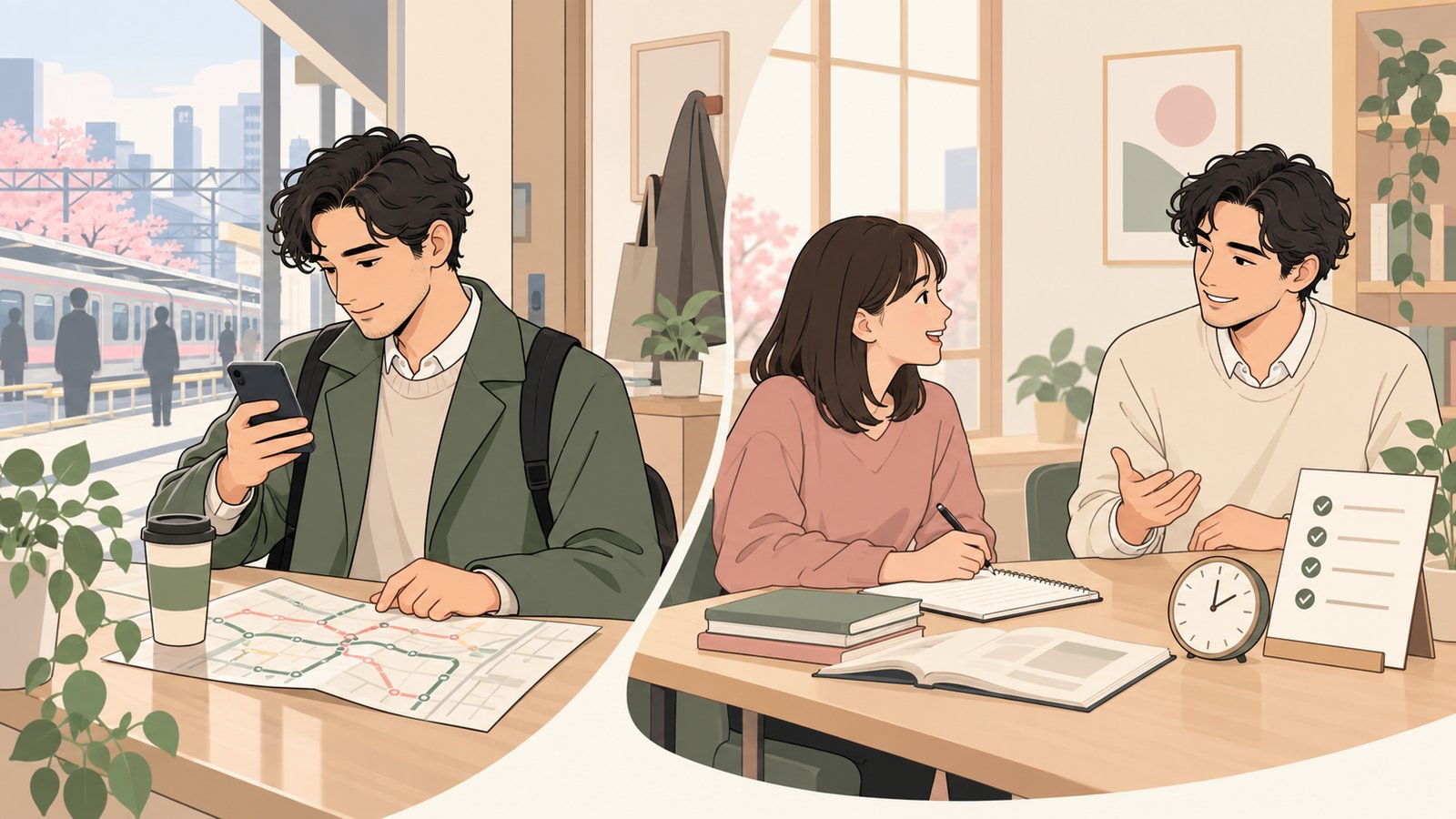
A flexible lesson rhythm
You do not need a rigid script, but a simple rhythm helps:
- Opening: Reconnect with the learner and agree on a small goal.
- Main practice: Give the learner time to speak, with prompts or a short activity if needed.
- Check: Notice one useful phrase or point to revisit; adjust if the activity is taking longer than expected.
- Closing: Summarize a success, give one manageable next step, and finish at the scheduled time.
The proportions change with the learner and the school’s format. If a learner is engaged in free talk, you need not abruptly stop a good exchange; use a natural transition such as “Before we finish, what was the most useful phrase today?” See our free talk guide for ways to make conversation purposeful.
Prepare enough, then leave room to adapt
Preparation can also consume time. Decide on one learner goal, a starting question, a backup prompt, and a closing question. Gather the material you need before the first lesson. Afterward, write a short note while the details are fresh, following the school’s record-keeping rules.
For a demo lesson, practice the opening and closing aloud as well as the main activity. That reveals whether your plan fits the allotted time. Our demo lesson guide covers the wider preparation.
The short checklist
- Know the current workplace’s start times, contact route, and delay procedure.
- Plan your actual door-to-door journey, including transfers and the last walk.
- Choose one small goal and one backup prompt for the lesson.
- Leave time to summarize and end at the agreed time.
- Record a useful next step in the way your school requires.
Time management is not about making every moment feel hurried. It gives the learner a reliable start, enough space to speak, and a clear finish.