


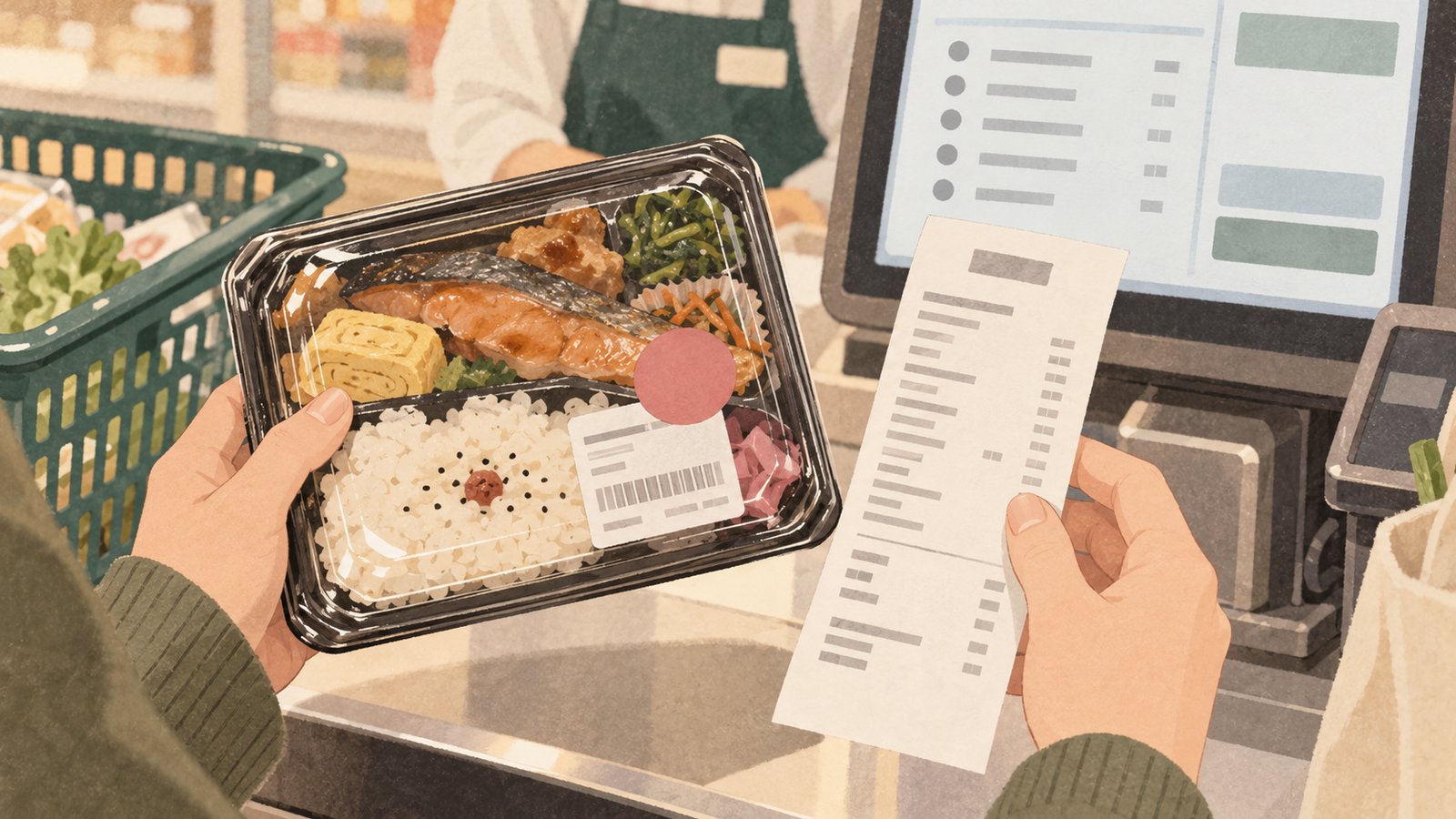
You pick up a pack of food and see a shelf price, a price on the package and a bright discount sticker. Which number will you pay? Start with the tax-included price (税込), check whether the label refers to one item or a weight, and read the sticker as either an amount off or a percentage off. If the final price is still unclear, ask at the register before paying.
Price-label Japanese at a glance
| Japanese | Reading | Meaning | What to check |
|---|---|---|---|
| 税込 | zeikomi | Tax included | The displayed amount includes consumption tax. |
| 税抜 / 本体価格 | zeinuki / hontai kakaku | Before tax / base price | Find the tax-included amount too. |
| 円 | en | Yen | Currency unit. |
| 1点 / 1個 / 1袋 | itten / ikko / hitofukuro | One item / piece / bag | Check how many are included. |
| 100g当たり | hyaku guramu atari | Per 100 grams | A comparison price, not necessarily the pack total. |
| 内容量 / 正味量 | naiyōryō / shōmiryō | Net contents / net weight | Compare pack sizes. |
| ○円引き | ○ en biki | ○ yen off | Subtract the stated amount, subject to the store’s price display and register. |
| ○%引き / ○割引 | ○ pāsento biki / ○ waribiki | ○ percent off / ○ tenths off | 2割引 means 20% off, not ¥20 off. |
| 半額 | hangaku | Half price | Check the applicable item and its final register price. |
| よりどり / お一人様○点限り | yoridori / ohitori-sama ○ ten kagiri | Mix and match / limit ○ items per person | Read the quantity conditions for a promotion. |
Read the tax-included price first
Japanese shelf tags sometimes show a prominent before-tax amount and a smaller tax-included amount. 税込 means the latter includes tax; 税抜 does not. For advance price displays aimed at consumers, Japan’s National Tax Agency explains the total-price display rule for shelf tags and store signs. That does not mean every number printed on a tag is a separate final price: stores may also show the before-tax amount. Look for the tax-included amount when comparing what you will pay.
Example: a tag showing 本体価格 198円 / 税込 213円 gives you two views of the same item. Use the printed 税込 213円 for a quick shopping decision. The example is illustrative; follow the actual shelf tag and receipt, including any applicable rounding or promotion.
Per 100 grams is not the package price
Meat and seafood often have a unit price and a price for that particular pack. A label might show 100g当たり 250円, 内容量 300g, and a separate pack price. Compare unit prices when pack sizes differ, but use the pack’s marked price to estimate the amount at checkout. Weight, tax and rounding can affect a calculation you do in your head.
Check whether a produce sign is for 1個 (one piece), 1袋 (one bag), or another unit. If two nearby sizes look alike, match the product name on the shelf label to the item in your hand.
Read a discount sticker without guessing
| Sticker example | Plain-English reading | If the applicable base price is ¥400 |
|---|---|---|
| 50円引き (gojū en biki) | ¥50 off | ¥350 in a simple example |
| 20%引き / 2割引 (nijū pāsento biki / ni waribiki) | 20% off | ¥320 in a simple example |
| 半額 (hangaku) | Half price | ¥200 in a simple example |
These examples show the arithmetic, not a promise about how every store calculates tax or stacks offers. Read any conditions near the promotion, check which item the sticker is attached to, and confirm the amount on the register screen or receipt. A shelf promotion and a package sticker may have different conditions; do not assume both discounts apply together.
A markdown does not extend a food’s date. For a discounted bento, read 消費期限 and 保存方法 on the package. Our guide to Japanese use-by and best-before labels explains the difference and links to the Consumer Affairs Agency’s guidance.
To practise reading unit prices on actual package types, see our meat-label guide and seafood-label guide.
A quick routine in the aisle
- Match the product. Check the shelf tag’s product name and the package size.
- Find the basis. Is the number per piece, per bag or per 100 grams?
- Find 税込. Use the tax-included display for the shelf price.
- Read the sticker. Distinguish 円引き from %引き and check any quantity conditions.
- Check the screen and receipt. Ask a staff member if the reduction did not appear as expected.
Short phrases you can use
| Japanese | Reading | Meaning |
|---|---|---|
| これは税込価格ですか。 | Kore wa zeikomi kakaku desu ka? | Is this the tax-included price? |
| この値段は一個あたりですか。 | Kono nedan wa ikko atari desu ka? | Is this price per piece? |
| このシールは何円引きですか。 | Kono shīru wa nan-en biki desu ka? | How many yen does this sticker take off? |
| 値引きが反映されていますか。 | Nebiki ga han’ei sarete imasu ka? | Has the discount been applied? |
Point to the exact shelf tag or package while asking. For the whole shopping flow, from basket to packing counter, see our grocery shopping guide for residents. For the food itself, the date and storage guide is a useful next step.