
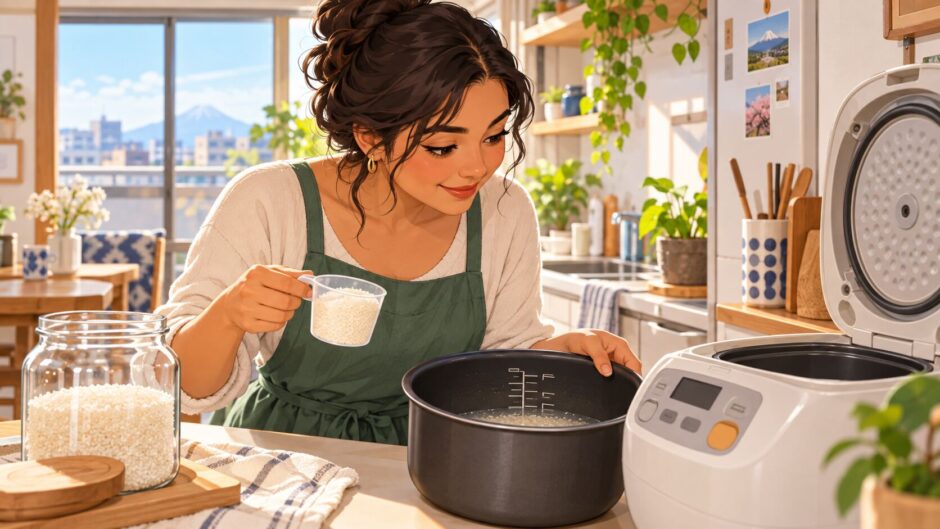

You have a Japanese rice cooker, a bag of rice and a panel marked 炊飯, 保温 and 予約. For a basic pot of white rice, measure the rice with the cooker’s cup, choose the matching white-rice water line inside the pot, select the white-rice course and press the cook/start button. Use your model’s manual for the exact sequence and for any special rice or mixed dish: button names and settings differ.
Japanese rice-cooker words at a glance
| Japanese | Reading | Meaning | Practical note |
|---|---|---|---|
| 炊飯 / 炊飯開始 | suihan / suihan kaishi | Cook rice / start cooking | Press after selecting the correct course and water level. |
| メニュー / コース | menyū / kōsu | Menu / cooking program | Cycles through rice types or cooking modes. |
| 白米 | hakumai | White rice | Common everyday course and pot scale. |
| 無洗米 | musenmai | No-wash rice | Choose this setting or water line if the model provides one. |
| 玄米 / おかゆ / 炊き込み | genmai / okayu / takikomi | Brown rice / rice porridge / mixed rice | Use the matching course and manual instructions. |
| 早炊き / 高速 | hayadaki / kōsoku | Quick cook / fast mode | Cooking time and result vary by model. |
| 保温 / 保温切 | ho-on / ho-on kiri | Keep warm / turn off warming | Not the same as starting a new cooking cycle. |
| 予約 / 予約1・2 | yoyaku / yoyaku ichi・ni | Timer / saved timer slots | Confirm whether the displayed time is finish time or time remaining. |
| 時 / 分 / 現在時刻 | ji / fun / genzai jikoku | Hour / minute / current time | Check the clock before setting a timer. |
| 取消 / 切 | torikeshi / kiri | Cancel / off | May stop a setting or turn off warming; check the panel. |
| 水位線 / 内釜 | suiisen / uchigama | Water-level line / inner pot | Use the scale for the selected rice type. |
Cook ordinary white rice: read the pot as well as the buttons
- Identify your rice. Look for 白米 (hakumai, white rice), 無洗米 (musenmai, no-wash rice) or 玄米 (genmai, brown rice) on the bag. These do not always use the same course or water scale. Our rice bag label guide helps identify what you bought.
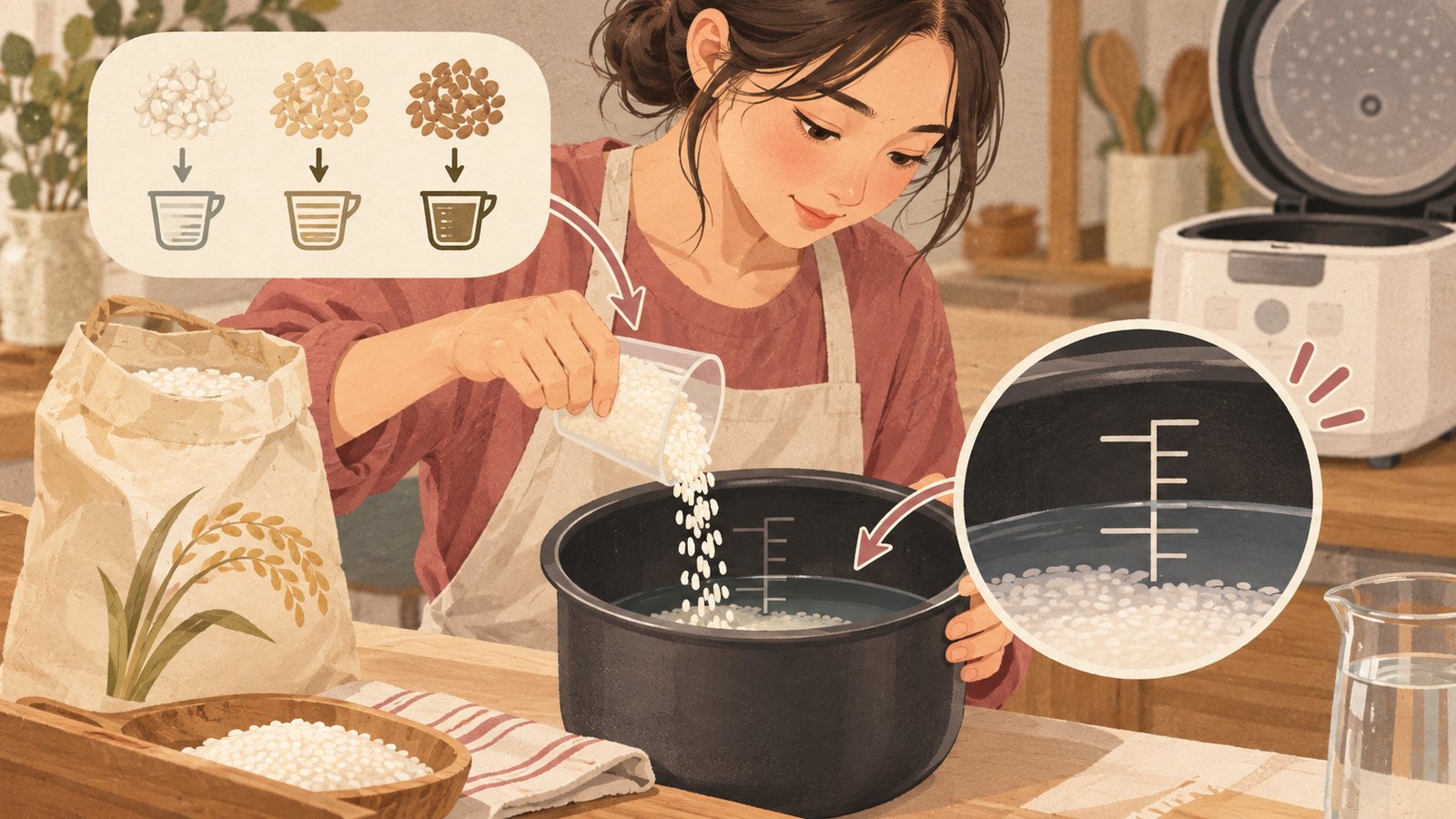
- Measure with the supplied cooker cup. Do not replace it with an arbitrary drinking mug. Follow the model manual for preparation and the amount it can cook.
- Choose the correct inner-pot scale. If you measured two cooker cups of white rice, look for the white-rice line marked 2, with the pot on a level surface. Panasonic’s water-level explanation says to measure rice with the supplied cup and add water to the line for the course and cup count. The pot can have several different scales, so do not use the first “2” you see.
- Wipe the outside of the pot, insert it and close the lid. Follow your manual for the inner lid and steam parts. Keep the steam outlet clear and take care when opening a hot cooker.
- Select 白米 and press 炊飯 or the model’s start key. Wait for the completion signal or display. Fluff the rice with a suitable paddle as the manual directs.
For 無洗米, read both the rice package and the cooker manual. Some cookers offer a dedicated no-wash-rice menu or water line. Zojirushi’s model description, for example, distinguishes its no-wash-rice menu and inner-pot markings. Do not assume every cooker has those settings.
What do 保温 and 取消 actually do?
保温 keeps cooked rice warm; it is not the button for cooking uncooked rice. Some models switch to warming automatically after cooking, while others offer a “no warming” choice. 取消 can cancel a timer or operation, and labels combined with 切 can turn warming off. Check the current display and your manual before pressing a button during cooking.
Do not leave food on keep-warm indefinitely. The allowed time and suitable dishes depend on the cooker. Zojirushi’s keep-warm guidance warns against exceeding the manual’s time and against keeping porridge or mixed rice with ingredients warm in that way. For leftovers, follow food-safety guidance and your appliance instructions rather than treating the warm setting as storage for any dish.
Reservation: finish time or hours from now?
On many models, 予約 sets when the rice should be ready, not when heating begins. Panasonic’s reservation FAQ explains this for its cookers and notes that if the selected finish time is too close, cooking may start immediately. Another model may display a countdown or have different timer behavior, so check its manual and current clock.
Use timer cooking only for ingredients and time spans permitted by your manual. Long soaking, especially in a warm room, can spoil rice; a timer is not a safe way to leave perishable toppings sitting in the pot. If you are unsure, cook plain rice without a reservation first.
Three common mix-ups
| What you see | Possible mix-up | Better check |
|---|---|---|
| 白米 and 玄米 scales both have “2” | Using the wrong water line | Match both the rice type and number. |
| 保温 lamp is on | Thinking rice is still cooking | Check whether the cooker has finished and switched to warming. |
| 予約1 and 予約2 | Assuming they mean one or two hours | They may be saved time slots; consult the manual. |
Find the right manual and ask a simple question
Look for the 型番 (kataban, model number) on the appliance label, then search the maker’s official manual page. A borrowed or secondhand cooker may be missing its printed booklet. The exact model matters more than a generic rice-cooker video.
| Japanese | Reading | Meaning |
|---|---|---|
| この炊飯器の型番はどこにありますか。 | Kono suihanki no kataban wa doko ni arimasu ka? | Where is this rice cooker’s model number? |
| 白米はどの目盛りまで水を入れますか。 | Hakumai wa dono memori made mizu o iremasu ka? | Which line should I fill to for white rice? |
| 予約は炊き上がる時刻ですか。 | Yoyaku wa takiagaru jikoku desu ka? | Is the reservation time when the rice will be ready? |
If you are shopping for rice and ingredients, our Japanese grocery shopping guide covers everyday labels and supermarket routines. For reheating leftovers, see our separate microwave button guide.