
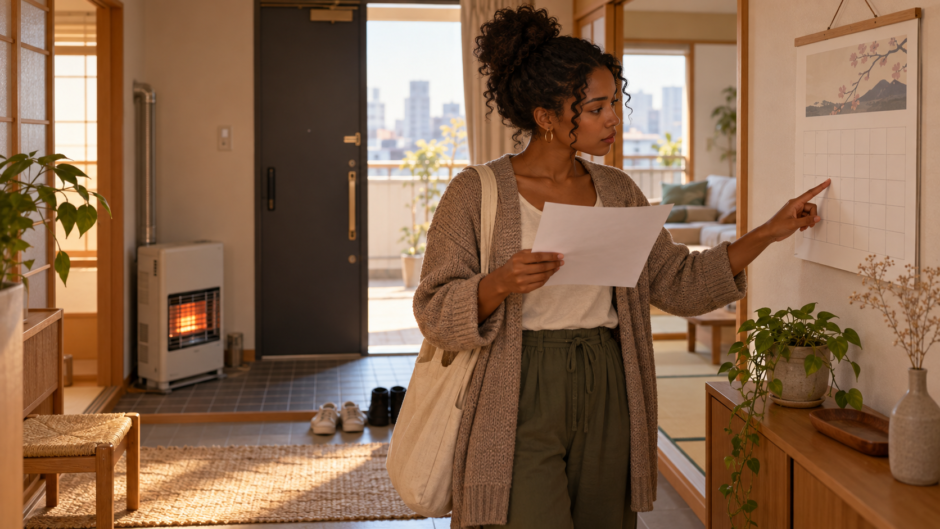

You find a notice in your apartment mailbox with ガス設備定期保安点検 at the top. Is it a bill, an appointment, or a warning? It is usually advance notice of a gas safety inspection. First check the proposed visit date and time, the company name, and whether the notice asks you to reschedule if you cannot be home.
This guide uses Tokyo Gas notices as a concrete example. The wording, inspection scope, and booking method differ by gas provider and by whether your building uses city gas or LP gas. Follow your own provider’s official instructions.
Words on the notice
| Japanese | Reading | Meaning and action |
|---|---|---|
| ガス設備定期保安点検 | gasu setsubi teiki hoan tenken | Periodic gas equipment safety inspection; check the scheduled visit. |
| 訪問予定日・時間帯 | hōmon yoteibi / jikantai | Proposed visit date and time window. |
| 点検日時の変更 | tenken nichiji no henkō | Change the inspection appointment. |
| 立会い | tachiai | Someone should be present; check whether this is required for your inspection. |
| ご不在連絡票 | go-fuzai renrakuhyō | Notice left because you were away; follow the provider’s booking instructions. |
| 点検結果のお知らせ | tenken kekka no oshirase | Inspection result notice; read it before assuming further action is needed. |
| お客さま番号 | okyakusama bangō | Customer number, sometimes needed to verify or change the appointment. |
What to do with the paper
- Identify the issuer. Compare the company name on the notice with your gas bill or the provider shown in your contract. In an apartment, ask the management company if you are unsure which company handles the equipment.
- Find the visit window. Look for 訪問予定日 and 時間帯. Put the date on your calendar. The notice may say whether someone must be home; some inspections can be completed outdoors, while others need access indoors.
- Change the date if necessary. Use the official website or contact details independently checked against your provider’s website or bill. Keep the paper because it may carry a customer or web entry number.
- If you missed the visit, read the slip. A result notice can mean the inspection was completed outside. An absence slip asking for a new date means it was not completed; contact the provider as instructed.
- Keep the result. Read any safety findings and contact the provider through its official channel if the result requires follow-up.
Tokyo Gas says it distributes advance notices with a proposed date and time, accepts changes online or by phone, and leaves different notices depending on whether an inspection was completed while the resident was away. See its periodic inspection guidance and absence guidance.
Short Japanese phrases
- 「ガスの点検のお知らせを受け取りました。」
Gasu no tenken no oshirase o uketorimashita.
I received the gas inspection notice. - 「予定日に在宅できません。日時を変更できますか。」
Yoteibi ni zaitaku dekimasen. Nichiji o henkō dekimasu ka?
I cannot be home on the scheduled day. Can I change the appointment? - 「この点検は室内への立ち入りが必要ですか。」
Kono tenken wa shitsunai e no tachiri ga hitsuyō desu ka?
Does this inspection require entry into the apartment? - 「不在連絡票が入っていました。再予約したいです。」
Fuzai renrakuhyō ga haitte imashita. Saiyoyaku shitai desu.
I found an absence slip. I would like to rebook.
Is it free? Is the visitor genuine?
Japan’s Kinki Bureau of Economy, Trade and Industry explains that legally required gas equipment inspections are performed without an inspection fee. A repair or separate service is a different matter: ask what it is and whether it costs money before agreeing. Read the bureau’s household guidance.
Do not let an unexpected visitor in solely because they say “gas inspection.” Tokyo Gas advises checking its advance notice and offers a way to confirm a scheduled visit; it also says its periodic safety inspection does not involve a fee. If something feels wrong, close the door and contact your gas provider using the number on its official site or your existing bill, rather than a number supplied by the visitor. Tokyo Gas’s impersonation warning gives examples.
If you smell gas or suspect a leak, treat it as an emergency. Follow your gas provider’s emergency instructions immediately; do not wait for a routine inspection appointment.
Related guides
Just moved in? See how to set up electricity, gas and water. If an apartment fixture needs attention, use our guide to reporting a broken fixture. For another building notice, read the apartment fire equipment inspection notice guide; it is a separate inspection. For other everyday notices and household tasks, return to our Living in Japan guide.