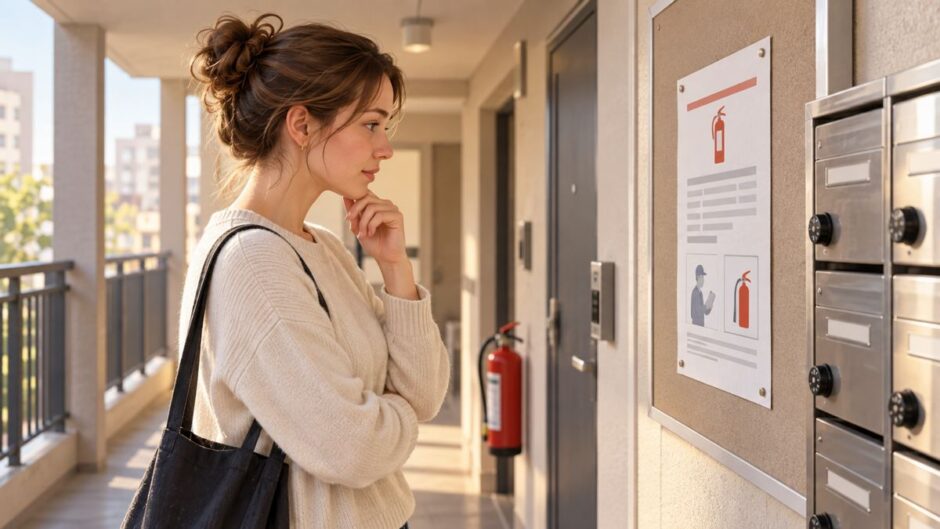

A notice headed 消防設備点検のお知らせ appears in your apartment lobby or mailbox. It usually announces a scheduled check of fire safety equipment. Your immediate task is to find the date and time, whether the inspector needs access to your unit, whether someone must be home, and whom to contact if you cannot attend. Do not infer those details from the title alone: the arrangements differ by building.
Words to scan on the notice
| Japanese | Reading | Meaning |
|---|---|---|
| 消防設備点検 | shōbō setsubi tenken | Fire equipment inspection |
| 実施日・実施時間 | jisshibi・jisshi jikan | Scheduled date and time |
| 対象住戸・対象階 | taishō jūko・taishō-kai | Affected units or floors |
| 室内点検・室内立入 | shitsunai tenken・shitsunai tachiiri | Inspection inside the unit / entry into the unit |
| 在宅・立会い | zaitaku・tachiai | Being at home / attending the inspection |
| 不在の場合 | fuzai no baai | Instructions if you will be absent |
| 予備日・再点検 | yobibi・sai-tenken | Alternative date / repeat inspection |
| 管理会社・管理組合 | kanri gaisha・kanri kumiai | Management company / owners’ association |
| 点検業者・連絡先 | tenken gyōsha・renrakusaki | Inspection contractor / contact details |
| 自動火災報知設備・感知器 | jidō kasai hōchi setsubi・kanchiki | Automatic fire alarm system / detector |
Fire equipment inspections are a real part of building safety management. The Tokyo Fire Department explains the inspection and reporting system for equipment such as extinguishers, alarms and sprinklers. The particular notice in your building determines what residents need to do on the day.
Read it in four steps
- Match the building and your unit. Look for the building name, 対象住戸 or 対象階. A lobby notice may concern common areas only, selected units, or every apartment.
- Mark the window of time. Find 実施日 and 実施時間. A broad time window does not promise an exact arrival time. If you need one, ask the management company.
- Check access instructions. 室内点検 and 立会い are the key words. If they appear, ask whether you need to be home, which areas or devices will be inspected, and how entry is arranged. Do not assume a worker may enter automatically if you are absent; follow the written notice and your building’s rules.
- Use the absence instructions early. If you cannot be home, read 不在の場合, 予備日 and the contact number. Ask for a rescheduled visit rather than waiting until the inspector arrives.
If someone arrives unexpectedly
A scheduled inspection is different from an unannounced person demanding immediate access, equipment replacement, or payment. The Tokyo Fire Department warns about contractors who pretend to be regular inspectors and pressure people into work or charges. If the visitor or price does not match the notice, pause and call your management company using a number you already have from your lease or building correspondence. In an emergency, follow your building’s emergency guidance.
Useful Japanese messages
| Japanese | Reading | English |
|---|---|---|
| 消防設備点検のお知らせを見ました。私の部屋も対象ですか。 | Shōbō setsubi tenken no oshirase o mimashita. Watashi no heya mo taishō desu ka? | I saw the inspection notice. Is my unit included? |
| 点検の日は在宅する必要がありますか。 | Tenken no hi wa zaitaku suru hitsuyō ga arimasu ka? | Do I need to be home on the inspection day? |
| その時間は不在です。別の日に変更できますか。 | Sono jikan wa fuzai desu. Betsu no hi ni henkō dekimasu ka? | I will be out then. Can it be changed to another day? |
| 点検業者の名前と作業内容を確認したいです。 | Tenken gyōsha no namae to sagyō naiyō o kakunin shitai desu. | I would like to confirm the contractor’s name and what they will inspect. |
For a normal fixture problem inside your unit, use our guide to reporting apartment repairs. If you are preparing to leave the apartment, the move-out checklist covers a different kind of inspection. Keep the building notice until the appointment is complete.
Fire inspection practice and warnings checked against Tokyo Fire Department guidance in September 2026. Dates, unit access, resident attendance and rescheduling are set by your building’s management notice and applicable rules.