
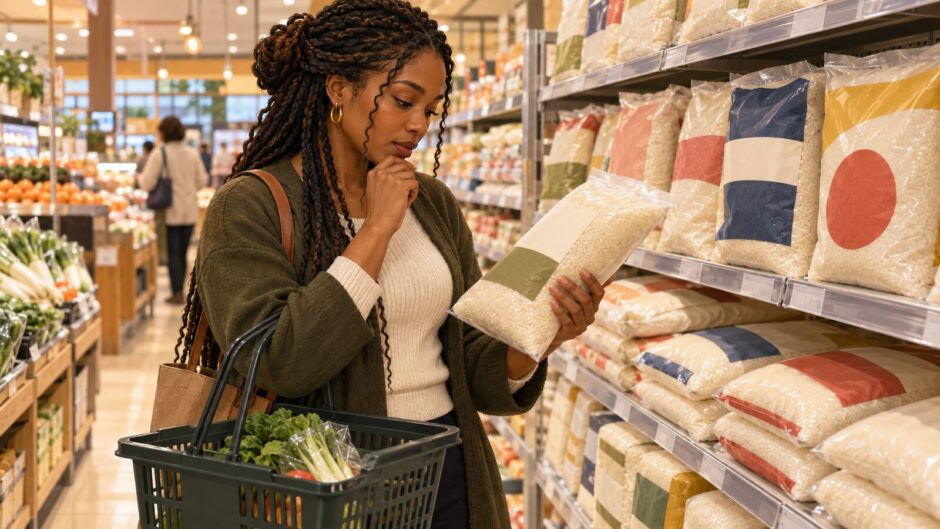

At a Japanese supermarket, two bags of rice may look almost identical until you find 無洗米 on one and 精米時期 on the other. For everyday white rice, first decide whether you want rice that needs rinsing or 無洗米, which does not need the usual pre-cooking wash. Then check the quantity, origin, variety, harvest year, and milling period on the bag’s information panel. The harvest year and milling period describe different events.
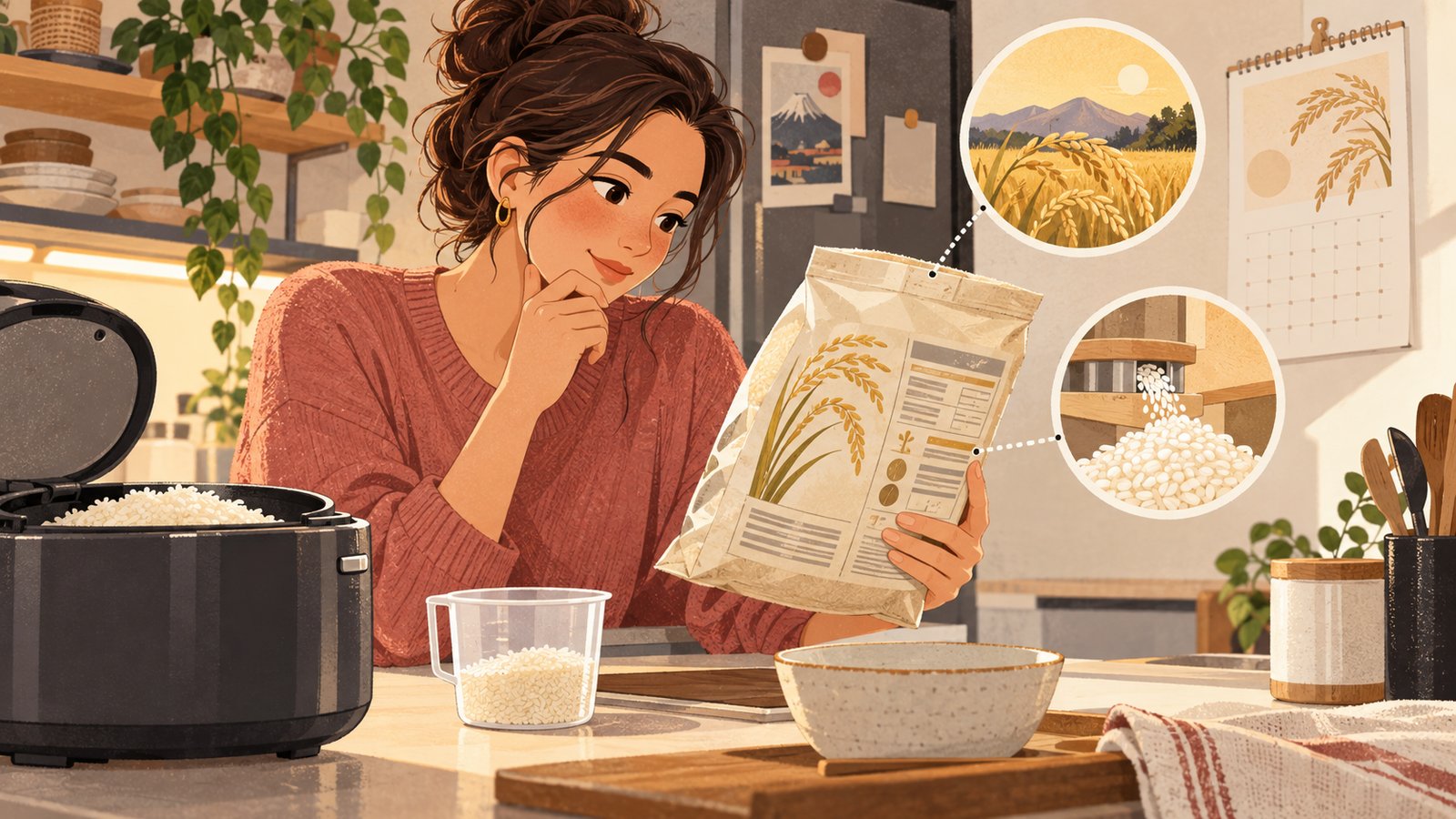
What the rice bag says
| Japanese | Reading | What it tells you |
|---|---|---|
| 名称 | meishō | Product type, such as polished rice |
| 精米/白米 | seimai / hakumai | Polished white rice |
| 玄米 | genmai | Brown rice with bran layer remaining |
| 無洗米 | musenmai | Rice processed so the usual rinsing before cooking is unnecessary |
| 原料玄米 | genryō genmai | Details of the brown rice used as the raw material |
| 産地 | sanchi | Growing origin |
| 品種 | hinshu | Rice variety |
| 産年 | sannen | Harvest year |
| 単一原料米/複数原料米 | tan’itsu genryōmai / fukusū genryōmai | Single-source rice / rice using more than one source of raw rice |
| 内容量 | naiyōryō | Net weight in the bag |
| 精米時期 | seimai jiki | When the rice was milled or polished |
| 販売者 | hanbaisha | Seller’s details |
Japan’s Ministry of Agriculture, Forestry and Fisheries lists the required information for rice sold to consumers, including product name, raw-rice details, net quantity, milling period, and seller. Look at the full information panel, not only the large words on the front.
Choose the type that fits your kitchen
Regular white rice: Follow the bag and rice cooker’s directions for washing and measuring. 無洗米: The usual washing step has already been addressed during processing, according to the ministry’s explanation of musenmai. It generally calls for a little more water than ordinary white rice, but use the 無洗米 water line or instructions for your cooker and the bag, rather than a universal extra amount. 玄米: Check that your cooker has a suitable brown-rice course and follow that product’s soaking and water directions; it is not a direct swap for white rice in a white-rice setting.
Our Japanese rice cooker buttons guide explains 白米, 玄米, and 無洗米 settings and water lines. The rice bag tells you what you bought; the cooker’s manual tells you how that model handles it.
Read the two dates correctly
産年 is the year the rice was harvested. 精米時期 is when the grain was milled; it is not an expiration date or the harvest date. The milling period may appear as a specific date or as 上旬 (jōjun, first part of a month), 中旬 (chūjun, middle), or 下旬 (gejun, last part). The Consumer Affairs Agency’s rice-labeling Q&A defines these periods as days 1–10, 11–20, and 21 to the end of the month. It also explains that a blend of rice milled at different times uses the oldest applicable milling period on the label.
For example, 産年:2025年 / 精米時期:2026年9月中旬 (sannen: 2025-nen / seimai jiki: 2026-nen 9-gatsu chūjun) means the rice was harvested in 2025 and milled during September 11–20, 2026. Do not read the milling period as a best-before deadline. If a label directs you to a date elsewhere on the bag, check that printed location.
A quick decision at the shelf
- Pick 精米 for ordinary white rice, 無洗米 for less washing, or 玄米 if you intend to cook brown rice.
- Check 内容量. A smaller bag may make more sense if you cook rice only occasionally. Compare the shelf price per weight as well as the bag price; our supermarket price-tag guide explains unit prices.
- Read 原料玄米, 産地, 品種, and 産年 for the actual rice inside. A large brand or regional name on the front is not a substitute for the information panel.
- Check 精米時期 and choose an amount you can store well and use. Store polished rice in a cool, low-humidity place away from sunlight; the ministry’s storage advice recommends refrigeration where practical and notes that quality declines after milling.
Useful question: これは無洗米ですか? (Kore wa musenmai desu ka? — Is this no-wash rice?) Or 精米時期はどこに書いてありますか? (Seimai jiki wa doko ni kaite arimasu ka? — Where is the milling period printed?)
Prices, stock, varieties, and package designs change by store and season. Check the specific bag and the current shelf tag when buying. For the whole trip from basket to packing counter, see our grocery shopping guide.