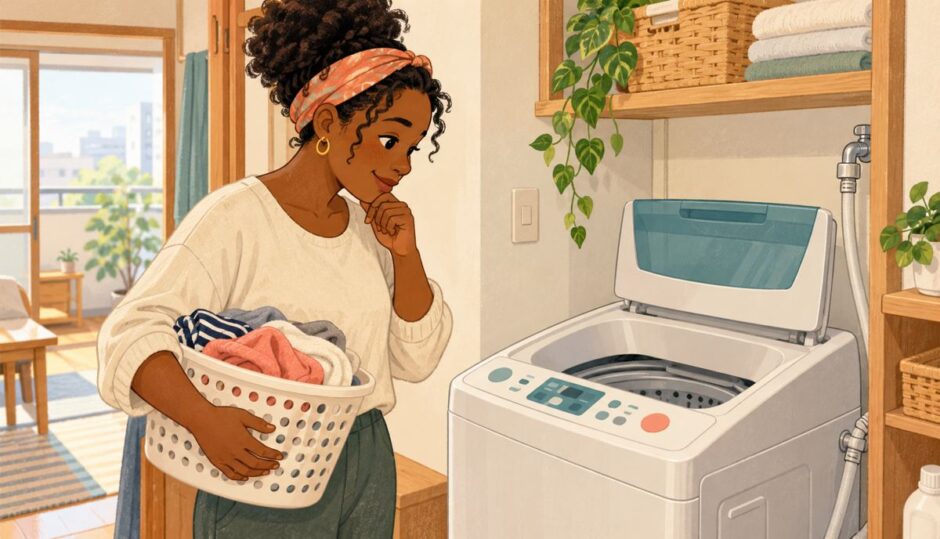

You have clothes in a Japanese washing machine, but the panel says 標準, すすぎ and 脱水. For ordinary machine-washable clothes, the basic sequence is to check the care labels, select the machine’s normal course (often 標準 or おまかせ), add detergent according to the machine and product instructions, then press スタート. The exact buttons and order vary by model. Most importantly, 脱水 means spin extraction, not heat drying.
Japanese washing-machine buttons
| Japanese | Reading | Meaning | What to expect |
|---|---|---|---|
| 電源 入/切 | dengen iri / kiri | Power on / off | Turn the machine on or off |
| スタート/一時停止 | sutāto / ichiji teishi | Start / pause | Begin or temporarily pause a cycle |
| コース | kōsu | Program | Choose a wash cycle |
| 標準/おまかせ | hyōjun / omakase | Standard / automatic | A usual choice for ordinary laundry on many models |
| おいそぎ/時短 | oisogi / jitan | Quick / short cycle | For appropriate lighter loads; check the manual |
| おしゃれ着/おうちクリーニング | osharegi / ouchi kurīningu | Delicates / gentle program | Use only if the garment’s care label permits machine washing |
| 洗い | arai | Wash | The washing stage or its duration |
| すすぎ | susugi | Rinse | Rinsing stage or number of rinses |
| 脱水 | dassui | Spin extraction | Removes water by spinning; clothes are not fully dry |
| 乾燥 | kansō | Drying | Only on machines with a drying function; check permitted fabrics |
| 水量 | suiryō | Water level | May be selected or measured automatically |
| 予約 | yoyaku | Timer / delayed operation | Check the display and manual for what time is being set |
| 自動投入 | jidō tōnyū | Automatic dispensing | Detergent or softener can be dispensed from a tank when configured |
| 槽洗浄 | sō senjō | Drum or tub cleaning | Maintenance program, not a clothes cycle |
These are a vocabulary guide, not a diagram of every machine. Hitachi’s example operating guide shows 水量, 洗い, すすぎ and 脱水 controls, but explicitly notes that some courses do not allow individual stages. Panasonic’s course descriptions also state that available settings differ by model.
A safe first wash of everyday clothes
- Read the garment care labels. Separate garments that require a different program or cannot be machine washed. Check pockets and close zippers as appropriate. Do not use a gentle cycle to override a “do not wash” label.
- Check the machine. Ensure the water tap is open if your model requires it, the drain hose is in place, and the lid or door closes properly. Follow the installed machine’s instructions.
- Load within the stated capacity. Select 標準 or おまかせ for ordinary eligible clothing. Panasonic’s beginner laundry guide describes standard, quick, delicate and bulky-item programs as different choices.
- Add the correct dose of detergent. Some machines measure the load after starting and then display a detergent amount; others have automatic dispensing. Read your machine’s display and detergent label. Our Japanese laundry detergent guide explains 洗剤 and 柔軟剤 and where they belong.
- Press スタート and wait until the cycle ends. Remove clothes promptly. If they are still damp after 脱水, that is normal; hang them or use a separate permitted drying process.
Wash, rinse, spin: three different stages
洗い washes with detergent. すすぎ removes detergent with water. 脱水 spins out water. On some machines you can choose a stage separately, but the button may cycle through settings and the program may restrict changes. Hitachi’s model-specific instructions show one way to set individual stages; follow your own model’s manual before attempting a spin-only or rinse-only cycle.
For a delicate garment, check both the care symbol and the course. Panasonic advises a suitable gentle course and detergent for eligible delicates in its garment-care guide. A short cycle is not automatically gentler than a delicate cycle.
Common surprises on the panel
- “脱水” is not “乾燥.” A spin cycle leaves laundry damp. If the machine has no 乾燥 function, it cannot heat-dry the load.
- “予約” is not an immediate start. Timer displays and whether they indicate a finishing time or delay depend on the model; check the manual before leaving a load scheduled.
- “自動投入” needs the correct setup. Do not assume a detergent tank is active or filled. Hitachi’s auto-dispensing guide explains that settings and detergent amounts must be configured for its machines.
- A flashing light may be an alert. Do not repeatedly restart without reading it. Hitachi notes that flashing panel lamps on certain models can indicate an abnormal condition; identify your model and follow its troubleshooting instructions.
Useful Japanese questions
| Japanese | Reading | Meaning |
|---|---|---|
| 普通の洗濯はどのコースですか。 | Futsū no sentaku wa dono kōsu desu ka? | Which program is for normal laundry? |
| 洗剤はどこに入れますか。 | Senzai wa doko ni iremasu ka? | Where do I put the detergent? |
| 脱水だけできますか。 | Dassui dake dekimasu ka? | Can I run the spin cycle only? |
| 取扱説明書はありますか。 | Toriatsukai setsumeisho wa arimasu ka? | Is there an instruction manual? |
For another unfamiliar appliance, see our microwave button guide. In a rental, ask the building manager for the washing machine’s model number or manual if the panel is hard to read.