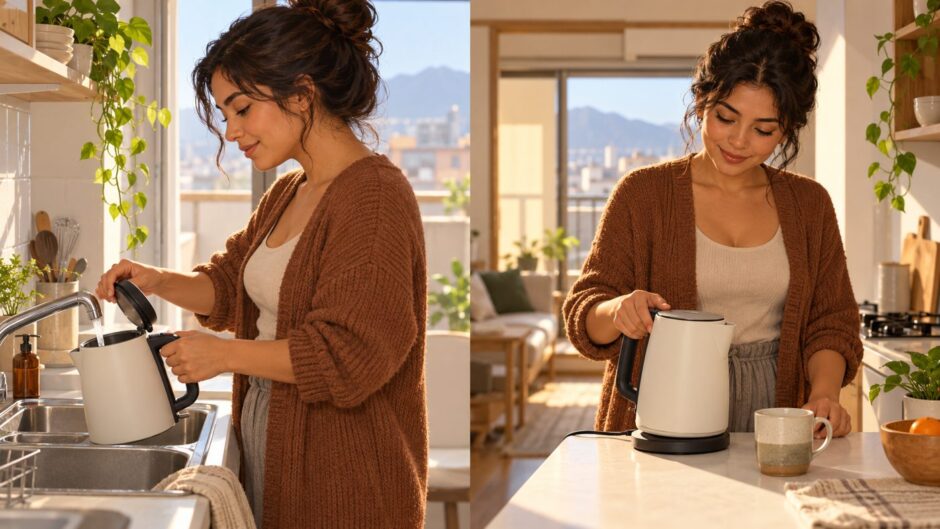

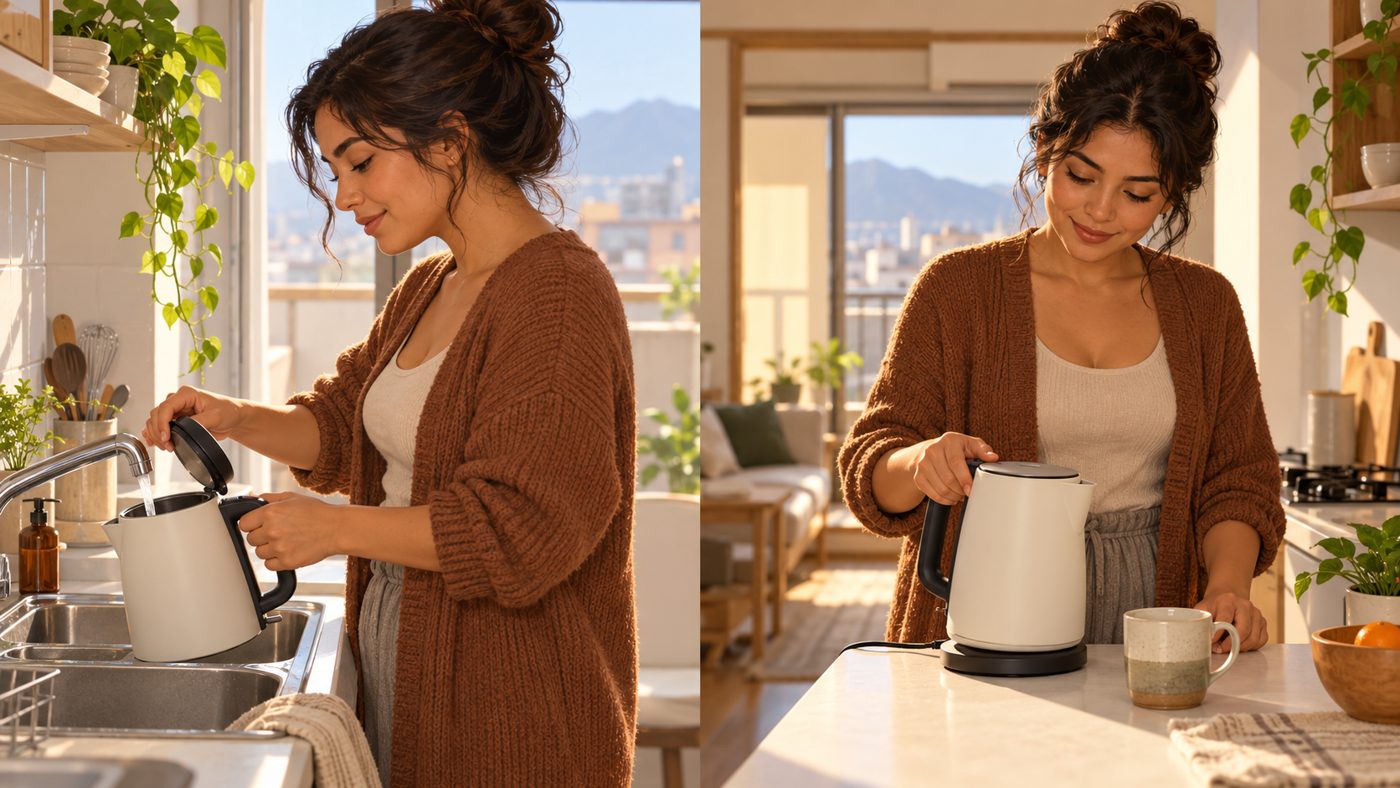
You have just moved into a Japanese apartment and found an electric kettle with a few unfamiliar labels. Start by checking the water level marks, filling the kettle with water, closing the lid, and using its boiling switch. Before pouring, check whether your model has a separate pour lock. The exact buttons vary, so use the model number on the kettle to find its manual.
Japanese words on an electric kettle
| Japanese | Reading | Meaning and what to check |
|---|---|---|
| 電気ケトル | denki ketoru | Electric kettle; usually used to boil water for immediate use. |
| 電源 | dengen | Power. May appear beside a switch or indicator. |
| 沸とう / 沸かす | futtō / wakasu | Boiling / boil. A lamp may light while water is heating. |
| 給湯ロック / ロック解除 | kyūtō rokku / rokku kaijo | Pour lock / unlock. Check its position before pouring; some kettles have no such control. |
| 満水 / MAX | mansui | Maximum fill mark. Do not fill past it. |
| 保温 | ho-on | Keep warm. Available on some models, not on every kettle. |
| 空だき防止 | karadaki bōshi | Protection against heating with too little or no water; still do not run the kettle empty. |
| 蒸気口 | jōkiguchi | Steam vent. Keep hands and face away while heating. |
Boil water in a shared or new apartment
- Find the model and fill marks. Look inside the kettle or on its water-level window. Fill with water between the minimum and maximum amounts specified in its manual. Do not add tea, milk, or soup unless that model expressly allows it.
- Close the lid and place it on its base. Keep the base and plug dry, and put the kettle on a stable surface with space for steam.
- Start boiling. Use the power or boiling switch shown in the manual. On many models, heating stops automatically after boiling; check the indicator and avoid assuming a lit or unlit lamp means the same thing on every model.
- Pour carefully. If there is a 給湯ロック button, release it as the manual directs. Wait for vigorous boiling to settle and keep clear of the spout and steam vent. Close the lock again afterward if the model provides one.
For one example, Zojirushi describes a boiling lamp, automatic shutoff, dry-boil protection, and a pour lock on its CK-DC series. Its manual page for the CK-SA series illustrates why checking your particular model is useful. Features and button positions are not universal.
If the kettle does not pour or seems to stop early
First check for a locked pour button; do not force the lid open over hot water. If heating stops with little water inside, unplug the unit and let it cool, then consult the manual before restarting. Dry-boil protection is a backup, not an instruction to heat an empty kettle. If a model has a 保温 setting, check whether it is actually selected; many simple electric kettles do not keep water hot after boiling.
A pour lock reduces accidental spillage but is not a leakproof seal. Tiger warns that hot water may still escape if a locked kettle is tilted or tipped. The warning is especially useful in a home with children or a crowded counter.
Useful Japanese to ask about the controls
- このケトルはどうやって沸かしますか。 Kono ketoru wa dō yatte wakashimasu ka? — How do I boil water with this kettle?
- ロックの解除方法を教えてください。 Rokku no kaijo hōhō o oshiete kudasai. — Please show me how to unlock it.
- 型番はどこに書いてありますか。 Kataban wa doko ni kaite arimasu ka? — Where is the model number written?
For other kitchen controls, see our guide to Japanese IH cooktop buttons. If you are preparing packaged food, the Japanese microwave guide covers common heating controls.