
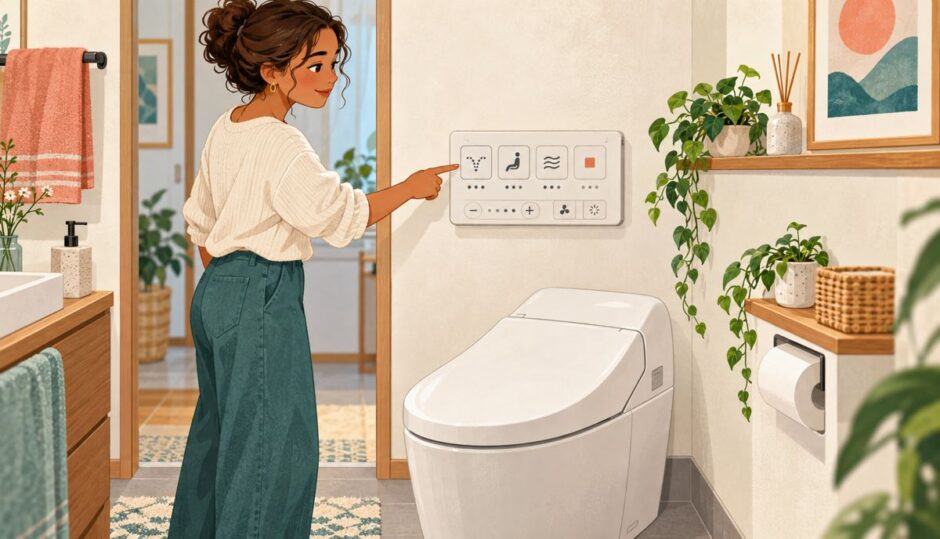

The wall panel beside a Japanese toilet can look like a small control center. The most useful distinction is simple: おしり and ビデ start the bidet spray, 止 stops it, and 流す or 大/小 flushes the toilet bowl. Stopping the spray does not necessarily flush the toilet. Buttons vary by manufacturer and model, so use the labels on the unit in front of you.
Common Japanese toilet buttons
| On the control | Reading | Meaning | What it does |
|---|---|---|---|
| おしり | oshiri | Rear wash | Starts a water spray for rear washing |
| ビデ | bide | Front wash | Starts a separate front-wash spray |
| 止 | tome | Stop | Stops the spray; often shown as a single kanji on the control |
| 水勢/洗浄強さ | suisei / senjō tsuyosa | Water pressure / wash strength | Adjusts spray strength, often with + and − |
| 洗浄位置 | senjō ichi | Spray position | Moves the spray position, if available |
| 温水温度 | onsui ondo | Water temperature | Changes spray water temperature |
| 便座温度 | benza ondo | Seat temperature | Changes heated-seat temperature |
| 乾燥 | kansō | Dryer | Starts warm-air drying, on models that have it |
| 流す/大/小 | nagasu / dai / shō | Flush / large / small | Flushes the bowl, if remote flushing is installed |
| 音姫/擬音 | otohime / gion | Privacy sound | Plays a simulated water sound, not a flush |
| ノズルそうじ | nozuru sōji | Nozzle cleaning | Maintenance function, not a wash setting |
A LIXIL feature guide lists separate rear/front wash, dryer and remote bowl-flush functions for a particular series. A LIXIL remote diagram shows labels such as 止, おしり, ビデ, 洗浄強さ, 流す大 and 流す小. Your panel may have fewer functions.
How to use the bidet spray
- Sit on the seat first. Many units have a seat sensor or switch and will not spray unless they detect a seated user. TOTO’s support guide notes that the sensor position differs by product.
- Choose おしり or ビデ. Start with a gentle water setting. LIXIL advises beginning at a weak setting and adjusting gradually in its product instructions.
- Press 止 to stop the spray. Some units stop automatically after a period, but press 止 when finished rather than relying on a timer.
- Flush separately. Look for 流す大 or 流す小, a separate wall button, or a manual lever. LIXIL’s flush instructions show 大 and 小 on one remote; other toilets flush automatically or have no remote flush.
Three easy mix-ups
- 止 stops the wash; it is not the flush button. If you see 流す or 大/小, that controls bowl flushing on the applicable model.
- 音姫 plays a sound. TOTO describes it as an electronic simulated flowing-water sound, developed to reduce wasteful flushing for privacy. It does not actually flush. See TOTO’s explanation.
- ノズルそうじ is for cleaning. Do not use a cleaning control as your first wash button. For model-specific cleaning steps, consult the manufacturer’s manual.
If nothing happens
Check whether you are seated fully and whether the remote has a working power or battery indicator. Some seat covers or child seats interfere with detection; TOTO’s troubleshooting page explains this for its products. If the spray still does not work, use the toilet normally and consult the exact model’s guide or building manager. Do not force a nozzle or take the unit apart.
Useful Japanese questions
| Japanese | Reading | Meaning |
|---|---|---|
| 水を流すボタンはどれですか。 | Mizu o nagasu botan wa dore desu ka? | Which button flushes? |
| このボタンは何ですか。 | Kono botan wa nan desu ka? | What is this button? |
| 水勢を弱くできますか。 | Suisei o yowaku dekimasu ka? | Can I lower the water pressure? |
| 説明書はありますか。 | Setsumeisho wa arimasu ka? | Is there a manual? |
For other controls in a Japanese home, see our guides to the air-conditioner remote and microwave buttons.