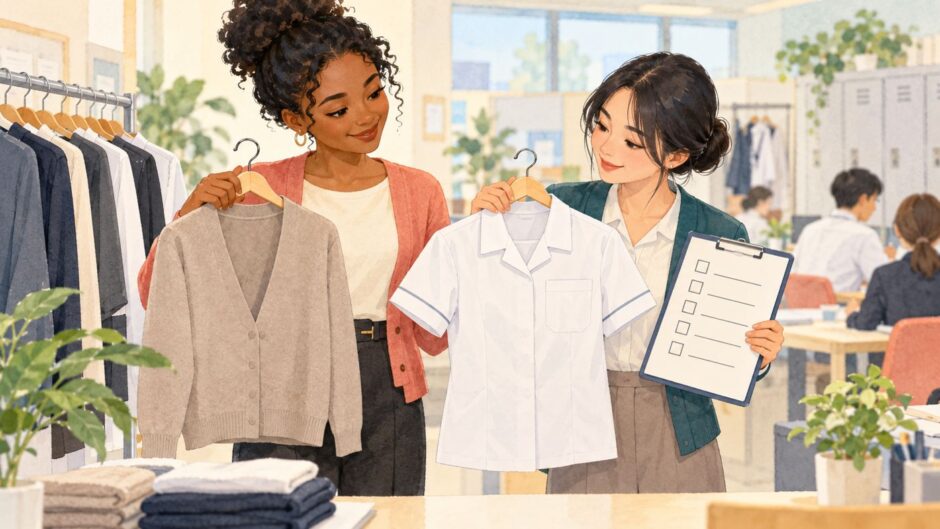

Your new workplace sends a 服装規定 (fukusō kitei) or 身だしなみについて (midashinami ni tsuite) notice. Before buying anything, check which items are required, which are supplied, where the rule applies, and whether it changes for a customer visit or season. Ask for a concrete example if a phrase such as 「清潔感のある服装」 feels too vague.
Words on the notice
| Japanese | Reading | Meaning / what to check |
|---|---|---|
| 服装規定・服装基準 | ふくそうきてい・ふくそうきじゅん (fukusō kitei / fukusō kijun) | Dress code or clothing standard |
| 身だしなみ | みだしなみ (midashinami) | Appearance and grooming at work |
| 指定・着用必須 | してい・ちゃくようひっす (shitei / chakuyō hissu) | Specified / required to wear |
| 制服・貸与 | せいふく・たいよ (seifuku / taiyo) | Uniform / loaned by the company |
| 支給・自己負担 | しきゅう・じこふたん (shikyū / jiko futan) | Supplied / paid by the employee; confirm what each applies to |
| 着用不可・禁止 | ちゃくようふか・きんし (chakuyō fuka / kinshi) | Cannot be worn / prohibited |
| オフィスカジュアル | オフィスカジュアル (ofisu kajuaru) | Office casual; details vary by workplace |
| クールビズ・ウォームビズ | クールビズ・ウォームビズ (kūru bizu / wōmu bizu) | Seasonal workplace clothing guidance; check dates and local rules |
| サイズ申請・交換 | サイズしんせい・こうかん (saizu shinsei / kōkan) | Size request / exchange |
| 洗濯・クリーニング・返却 | せんたく・クリーニング・へんきゃく (sentaku / kurīningu / henkyaku) | Washing / cleaning / return of an issued item |
Five checks before the first day
- Find the setting. A rule for customer-facing work may differ from one for desk work, site visits or remote meetings. Read the section for your job and the date it takes effect.
- Separate required from recommended. 「着用必須」 is a requirement; 「推奨」 is a recommendation. If the notice says 「清潔感のある服装」 without examples, ask the team what people normally wear in that setting.
- Find out who provides each item. Uniform, shoes, name badge and protective clothing may have different arrangements. Ask about sizes and exchange procedures before buying a substitute. Do not assume that 支給 and 貸与 mean the same ownership or return rule.
- Read exceptions and seasonal dates. A Cool Biz period, a special event, a client visit or safety requirement may change the usual guidance. Follow current workplace instructions rather than a broad idea of “Japanese office attire.”
- Keep the handling instructions. For a loaned uniform, check washing, storage and the return method. If you later transfer or leave, compare the item with the company’s 貸与品返却 list.
Questions you can send
First-day clothing: 「初日の服装について、指定のものはありますか。」
Shonichi no fukusō ni tsuite, shitei no mono wa arimasu ka?
“Is anything specified for what I should wear on the first day?”
Clarify a vague term: 「オフィスカジュアルの範囲について、着用不可の例を教えていただけますか。」
Ofisu kajuaru no han’i ni tsuite, chakuyō fuka no rei o oshiete itadakemasu ka?
“Could you give me examples of clothing that is not allowed under the office casual rule?”
Uniform fit: 「貸与された制服のサイズが合わないため、交換方法を教えてください。」
Taiyo sareta seifuku no saizu ga awanai tame, kōkan hōhō o oshiete kudasai.
“The loaned uniform does not fit. Please tell me how to exchange it.”
Handling: 「制服の洗濯と退職時の返却方法を確認したいです。」
Seifuku no sentaku to taishokuji no henkyaku hōhō o kakunin shitai desu.
“I would like to confirm how to wash the uniform and return it when leaving.”
Workplace and role matter more than a general rule
There is no single outfit for every job in Japan. A company’s notice may specify shoes, hair restraints or protective items for a particular task, while another team has no uniform. Follow the actual workplace instruction and ask the named contact if it conflicts with what your manager told you. For a teaching role, the separate eikaiwa teacher dress code guide discusses interviews and lessons. If the dress notice came with your first-day email, confirm the arrival place and time there as well.