
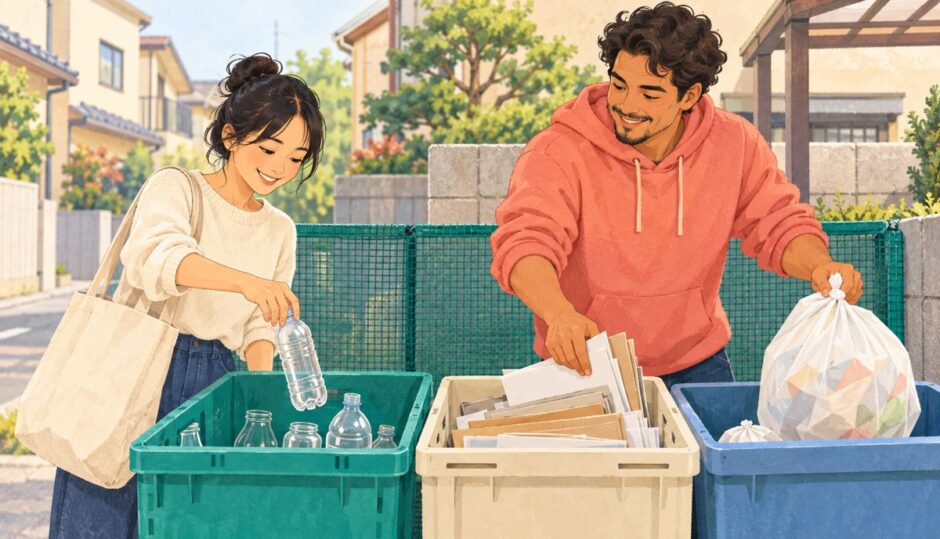

You have a bag of household waste, but the collection notice says 燃やすごみ, 資源 and 粗大ごみ. What goes where? The practical answer is to use your own municipality’s sorting guide and your building’s collection notice together. Japan has no single collection calendar or identical sorting rule for every city. A bottle, plastic item or large object may need a different route depending on its material and your address.
Read the words on the collection notice
| Japanese | Reading | English | What to check |
|---|---|---|---|
| ごみの分別 | gomi no bunbetsu | Waste sorting | Which category an item belongs to |
| 燃やすごみ/可燃ごみ | moyasu gomi / kanen gomi | Burnable waste | Your city’s item list |
| 燃やさないごみ/不燃ごみ | moyasanai gomi / funen gomi | Non-burnable waste | Which metals, glass or other items qualify locally |
| 資源/資源ごみ | shigen / shigen gomi | Recyclables | Whether bottles, cans, paper and plastics have separate collection |
| ペットボトル | petto botoru | PET beverage bottles | Caps, labels and rinsing instructions |
| プラスチック資源/容器包装プラスチック | purasuchikku shigen / yōki hōsō purasuchikku | Plastic resources / plastic packaging | Which plastics your municipality accepts |
| 粗大ごみ | sodai gomi | Bulky waste | Application, fee and pickup process before disposal |
| 収集日/回収日 | shūshūbi / kaishūbi | Collection day | The day for each category at your address |
| 集積所/ごみ置き場 | shūsekijo / gomi okiba | Collection point | Your building’s or neighborhood’s designated place |
| 朝8時まで | asa hachi-ji made | By 8 a.m. | A common example, but verify your local deadline |
Four steps before you put a bag out
- Find your local guide. Search your city or ward name plus ごみ 分別, or ask the city office or building manager. Shinjuku offers multilingual guides and an app; Yokohama has an English sorting page and app. Use the guide for the municipality where you actually live.
- Look up the exact item. Material alone may not decide the category. Check whether a plastic bottle, its cap and its label go together locally. For a mixed-material item, use the city’s item-by-item search or ask the waste office.
- Find the day and place. Read the notice at your building’s ごみ置き場 or ask the manager. The street address and building rules matter. Keep categories separate as instructed and use any required bags or containers.
- Set it out at the permitted time. Do not assume the previous night is allowed. Yokohama, for example, tells residents to use the designated collection point by 8 a.m. and not to leave waste there the night before. Check Yokohama’s official rules; another city or district may specify a different time.
A real example of why location matters
Shibuya City’s English guide distinguishes burnable waste, non-burnable waste and recyclable resources, and gives its own collection frequency and deadline. Yokohama’s guide has its own categories and item search. Both are useful examples of how a municipality explains its system; neither is a national rule. Collection dates may differ even within a city.
Items that need a separate check
Furniture and large items: Look up 粗大ごみ before putting an object out. An advance booking and a charge may apply, and the size threshold varies. Batteries, spray cans, electronics and appliances: Do not guess from “burnable” or “non-burnable.” Search the exact item in your municipal guide; some products have separate collection or recycling routes. Business waste: Household collection rules may not apply to a workplace. Ask the operator or local authority.
Short Japanese questions you can use
| Japanese | Reading | Meaning |
|---|---|---|
| これは何ごみですか。 | Kore wa nan-gomi desu ka? | What waste category is this? |
| ごみは何曜日に出せますか。 | Gomi wa nan-yōbi ni dasemasu ka? | What day can I put out the waste? |
| ごみ置き場はどこですか。 | Gomi okiba wa doko desu ka? | Where is the collection point? |
| 粗大ごみは予約が必要ですか。 | Sodai gomi wa yoyaku ga hitsuyō desu ka? | Do I need to book bulky-waste collection? |
If you are new to the building, ask its manager for the collection calendar. Our guide to Japanese apartment listings helps with another part of settling in, and our laundry label guide explains everyday product vocabulary.